
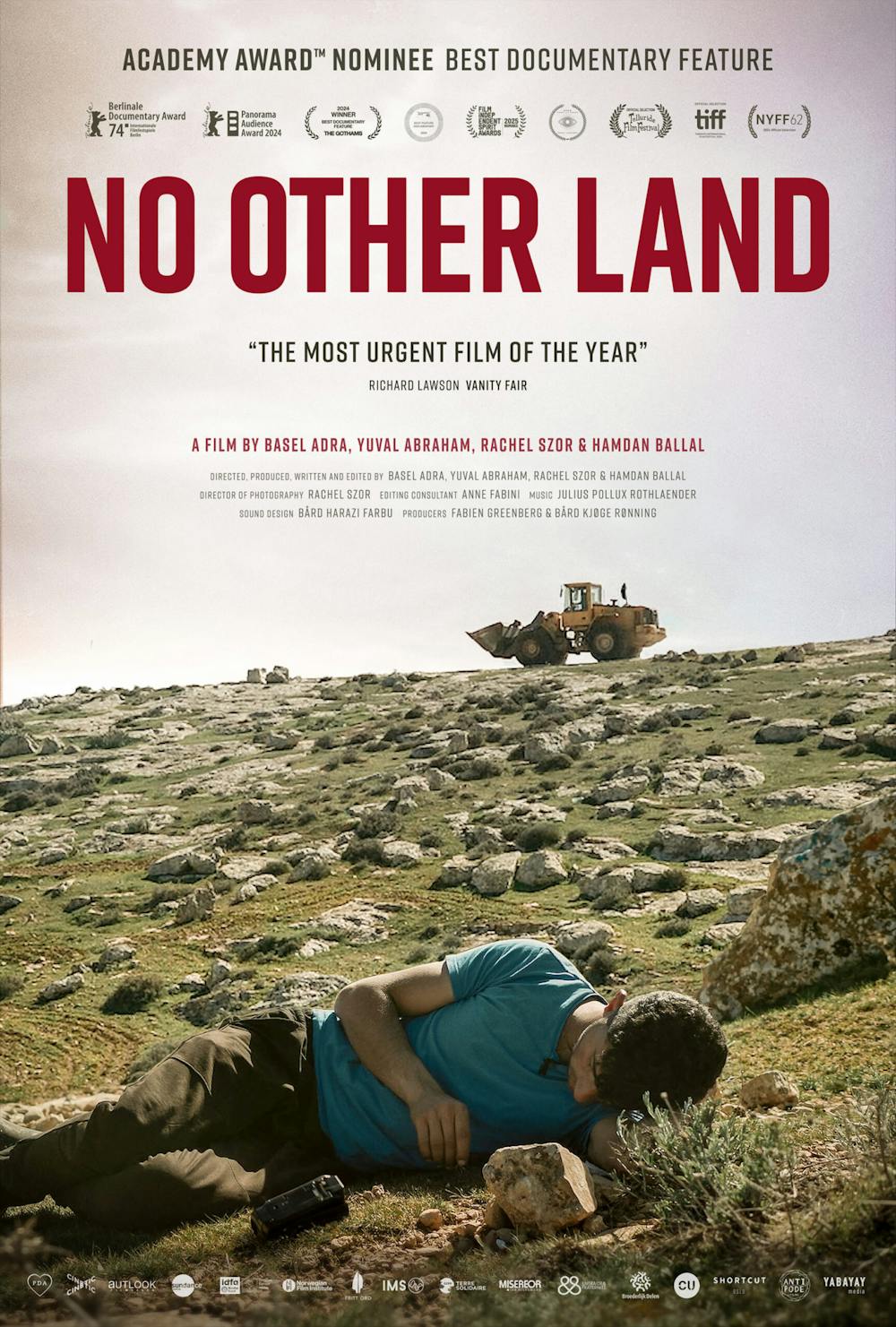
“No Other Land,” a profoundly moving documentary produced by a Palestinian-Israeli collective, was screened on April 10 to a packed Dana Auditorium as part of the Hirschfield International Film Series. The film is directed by debut filmmakers Basel Adra, Hamdan Ballal, Yuval Abraham and Rachel Szor.
The film premiered in February 2024 at the Berlin International Film Festival, where it won the Berlinale Documentary Film Award. Critics around the world praised the work, and it earned a nomination from the British Academy Film Awards (BAFTA) as well as the Academy Award for best documentary.
Following the Oscars, Ballal was injured in an attack by Israeli settlers and detained overnight by Israeli soldiers. The film has since been denounced by both Israel’s Minister of Culture as “defamation” and “sabotage” against the state of Israel and the pro-Palestinian Boycott, Divestment, and Sanctions (BDS) movement, who accused the project of violating the organization’s “anti-normalization” guidelines.
Despite international acclaim, the heavily politicized film in the U.S. has yet to find an American Distributor to bring it to streaming services. However, it has premiered across several independent theaters across the U.S. who acquired the film through self-distributors.
Last Thursday, students and community members queued outside Dana Auditorium before the film’s start time of 7 p.m., but with every single seat filled, many were turned away. Student and faculty organizers of Hirschfield mentioned a possible second screening to allow those interested the opportunity to watch the film. Needless to say, interest in the controversial and widely discussed film was high.
Filmed between 2019 and 2023, the documentary depicts the ongoing destruction of Masafer Yatta, a Palestinian cluster of villages in the occupied West Bank, and the community’s efforts to resist the Israeli occupation. The film also depicts the friendship between co-directors Basel Adra and Yuval Abraham, a Palestinian activist and Israeli journalist. The film draws on found footage from Adra’s friends and family filmed as early as 20 years ago.
Masafer Yatta has been home to Palestinian families since the early nineteenth century, according to villagers in the film. Following Israel’s occupation of the territory in the Six Day War, the Israeli military designated the area a “live fire” training zone, and the community’s existence on the land became illegal. Palestinians appealed to Israeli courts, but a verdict was delayed for over 20 years. During that time, the military regularly destroyed Palestinian villages.
“They destroy us slowly. Every week, a home. Every week a new family must decide: endure, or leave their land,” the narrator says.
Denied building permits, Palestinian residents rebuilt their communities under cover of darkness, without access to water or electricity, yet they found ways to survive. In 2022, the Israeli Supreme Court finally sided with the military, permitting it to expel remaining residents from the area.
“No Other Land” portrays the military’s forced entry into villages, during which soldiers showed up with bulldozers to raze the villagers’ homes, wells and schools. A makeshift children’s playground is destroyed, water pipes are sawed and generators confiscated. Palestinian villagers and activists protest the destruction, documenting the events with their cellphones and Adra with his camcorder. The villagers have no legal recourse, and the futility of their situation is heartbreaking.
In a disquieting scene, a tug of war over a generator ensues, and a Palestinian villager is shot and paralyzed by an Israeli soldier. In his home, the villager’s mother tells the film crew that she wishes her son had died to be put out of his suffering. Throughout the screening, the audience was audibly shocked by scenes of destruction and violence. Few minutes of the film pass without the sound of cries of young children and the protests of villagers. Repeatedly, villagers ask the guards why this is happening. The answer is always the same: “This is legal” or “Because the courts say so.”
“No Other Land” reveals the unlikely friendship between Adra and Abraham. They meet during one of the military’s demolitions, where Adra is filming and Abraham is writing an article. Adra regards Abraham warily at first, but the pair quickly become collaborators. Even as they grow closer, there is an inescapable tension between the pair.
Even in the West Bank, Abraham is protected by Israeli law and able to move freely throughout the country, while Adrais unable to leave the West Bank or enter Israel. Like other residents of Masafer Yatta, he is not protected by Israeli law, but subject to rule by military tribunal as established at the beginning of the occupation.
The pair have vulnerable conversations, sharing how they hope their work will bring attention to the suffering of Palestinians, but they grow increasingly doubtful of their capacity to evoke change. Adra grew up in a family of activists and has been fighting the occupation his whole life. His first memory is of Israeli soldiers entering his home and arresting his father. His father is arrested again in the film.
The end of “No Other Land” includes footage shot after the documentary had wrapped, following Hamas’ October 7 attack. Emboldened and vengeful settlers, accompanied by Israeli soldiers, descend on villages in Masafer Yatta. In a confrontation, Adra’s cousin is shot and injured. Due to the global attention brought by the film, violent settler attacks on the community have increased, occurring as recently as this week.
As the credits rolled, silence filled the auditorium; the applause was short and solemn. The audience Q&A was subdued; some community members expressed interest in finding spaces to discuss the film and ongoing political developments to grapple with the troubling realities of the West Bank that were exposed by “No Other Land.”
Thie Harthono '28 (he/him) is a Sports Editor.
Thie is majoring in Political Science. On campus, he serves as a Peer Writing Tutor. He spent the summer as a Press Intern at the United States Senate.


