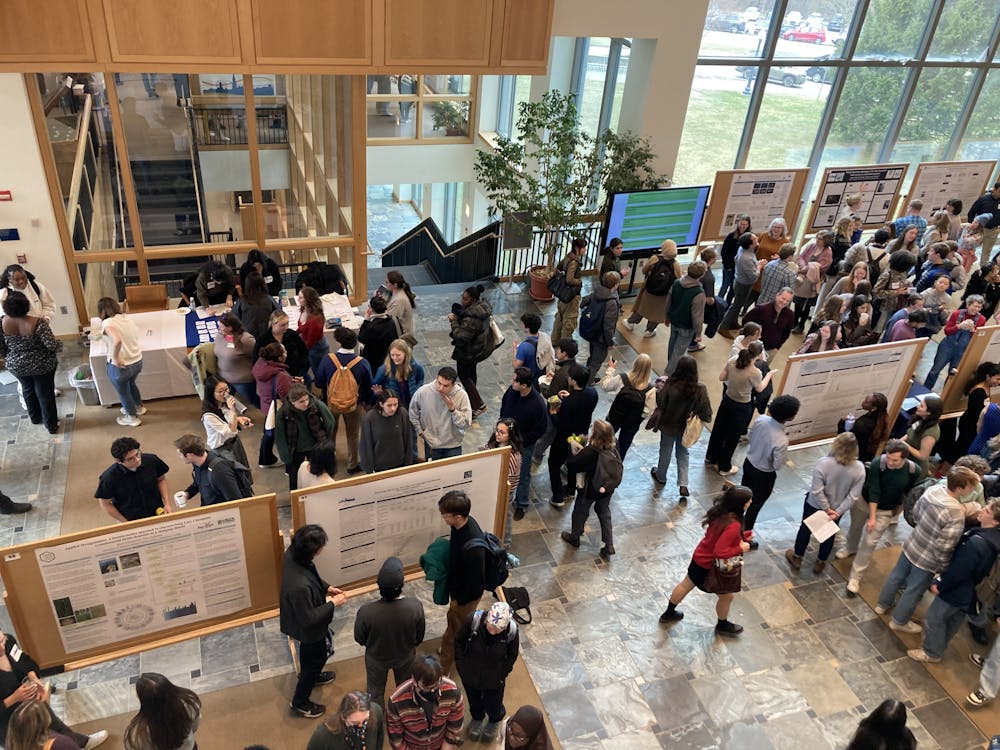
On April 11, students, faculty and visitors filtered through BiHall to explore the 248 student research projects and presentations given at the annual Spring Student Symposium. Community members stood shoulder-to-shoulder in the packed Great Hall during poster sessions and hopped around classrooms throughout the building to listen to students presenting research, enjoying the plethora of topics explored at this year’s event.
“This year, we had so many students clamoring to present that we easily outgrew what the Great Hall could accommodate and were able to turn to the Q-Center as a generous, convenient space for poster presentations to grow,” said Amy Morsman, professor of History and co-director of this year’s research showcase who spoke at the opening of the symposium.
Presentations were split into two categories: 15-minute individual lectures and general sessions of poster displays. Topics ranged from exploring the role that art plays in the Afghan refugee community to developing a three-dimensional microscope to image blood samples. Each project aligned with the shared goal of academic exploration.
When he opened the symposium on Friday morning, Interim President Steve Snyder told the assembled crowd he looked forward to a range of diverse presentations that day from all areas of the college’s academic disciplines.
“This is the 18th annual Spring Student Symposium, which highlights students’ research and creative work across the arts and sciences alike,” Snyder said. The interim president moderated an early morning presentation session, joining many faculty and administrators who took time out of their Friday schedule to facilitate an hour-long set of student lectures.
Beginning in 2007 with just 60 participants, the Spring Student Symposium has grown dramatically since its establishment. Students came to explore majors and potential research opportunities, support friends and to have the opportunity to learn about work across academic departments.
To direct this year’s event, Morsman and Professor of Anthropology Michael Sheridan led a committee with Assistant Professor of Biology Greg Pask, Associate Professor of History of Art & Architecture Erin Sassin and Assistant Professor of Chinese Chialan Sharon Wang.
“It just doesn’t happen on its own. It takes work — a lot of it — to execute this extravaganza of student creation,” Morsman told the crowd on Friday morning.
Many student presenters spoke to the excitement of sharing their work with a broader audience of students across campus and disciplines. Maya Teiman ’25, who gave a presentation titled “Public Perceptions of Climate Solutions at Middlebury College,” said that having a designated space where people wanted to learn more about her work was meaningful.
“This is my first symposium; I’ve never done it before, but I think it’s a great way to be more intentional about research and get it out there. Day to day, I think people don’t really care about my research just because most of my friends are tired of hearing me talk about it, but it’s nice to know that people actually have an interest,” Teiman said.
Salomé Monero ’25, another student presenter, emphasized the importance of the symposium as a space for dialogue across disciplines.
“Before my time, there was a commons system, which means that there was an intellectual community on campus, and I feel like nowadays people are hesitant to have that sort of conversation outside of the classroom. I feel like the symposium opens up the conversation or the liberal arts experience where the students are interested and excited to continue engaging with these intellectual topics,” Monero said.
Monero’s talk, “Bridging Cognition and Communication: The Impact of Language Awareness on L2 Learning,” focused on how understanding linguistics can impact learning a second language. Monero said she enjoyed hearing from non-linguistics focused students and being able to share her passion with those who have never studied linguistics before.
Assistant Professor of Statistics Alex Lyford noted how particularly interdisciplinary presentations were at this year’s symposium and was highly impressed with presenters across all levels of courses.
“Nowadays, every research project that students present is interdisciplinary and utilizes a wide variety of perspectives and approaches. Thesis work has always been impressive, but I watched several students present work they did in an introductory or low-level elective course, and it was phenomenal!,” Lyford wrote in an email to The Campus.
As the number of presenters at symposium has grown, Lyford has noticed that general enthusiasm and student support for their friends has grown as well.
“I’ll admit that when I started in 2017, many students treated the Symposium as a “day off” from classes. I don’t have any data to support this, but I don’t hear any students expressing that sentiment anymore, and the turnout has been fantastic,” Lyford wrote. “It’s great to watch basically the entire track team show up to support one of their peers at their presentation. I didn’t notice this happening 8 years ago.”
David Torres ’28, a symposium attendee, said he appreciated the level of depth that the symposium presentations showcased.
“It meets the expectation of academic inquiry and the way that you’re able to discuss your research in a manner that dives into not just surface level inquiries, but full on investigations that could potentially shape that career or field,” Torres said.
Alongside the celebration of student research, the recent event emphasized Middlebury’s vibrant academic community. As Sheridan said in his welcome speech, “The symposium is Middlebury at its best.”
For the event’s directors and for many others, the Spring Student Symposium embodies the values they appreciate in their liberal arts educations: Curiosity, depth and community.
Editor’s Note: Editor in Chief Ryan McElroy ’25 and News Editor Evan Weiss ’25 contributed reporting to this article.
Rachelle Talbert '28 (she/her) is a News Editor.
Rachelle previously served as a copy editor. She is an English major with an intended minor in Art History. Outside of writing, she volunteers with Page One Literacy and experiments with visual and fiber arts.