
This week’s Performing Arts Spotlight features guest writer Su Zheng, Associate Professor of Music at Wesleyan University. She previews the upcoming concert by Wu Man and the Shanghai Quartet, Thursday, Oct. 29 at 7:30 p.m. at the Mahaney Center for the Arts (MCA).
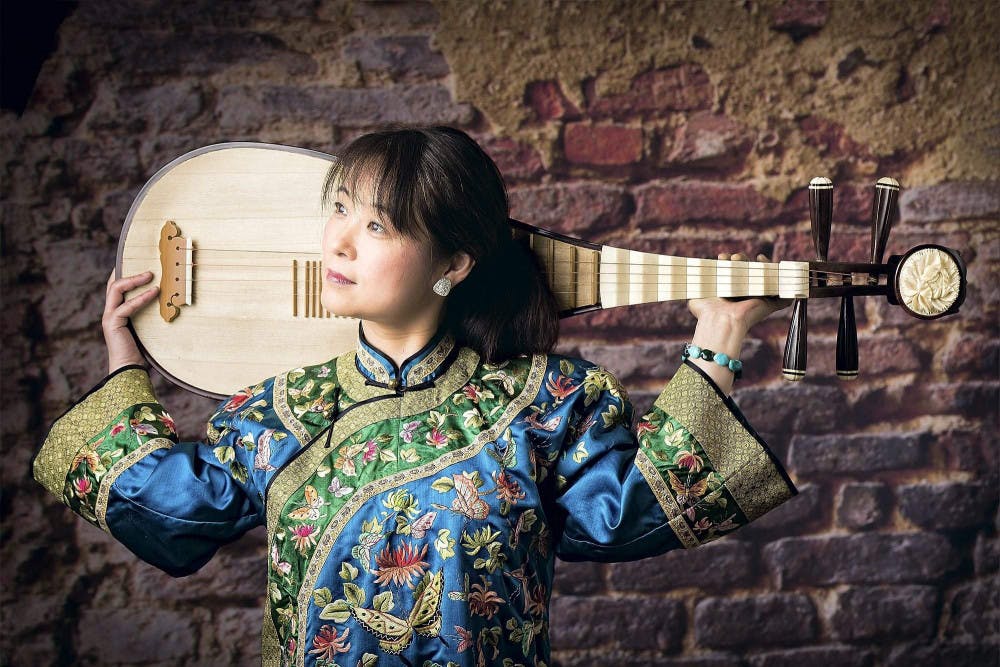
“The pipa is a lute-like instrument with a history of more than two thousand years. During the Qin and Han Dynasties (221 B.C.–220 A.D.), instruments with long, straight necks and round resonators with snakeskin or wooden soundboards were played with a forward and backward plucking motion that sounded like “pi” and “pa” to fanciful ears. Hence, all plucked instruments in ancient times were called “pipa.” During the Tang dynasty, by way of Central Asia, the introduction of a crooked neck lute with a pear-shaped body contributed to the pipa’s evolution. Today’s instrument consists of twenty-six frets and six ledges arranged as stops and its four strings are tuned respectively to A,D,E,A. The pipa’s many left and right hand fingering techniques, rich tonal qualities and resonant timber give its music expressiveness and beauty that are lasting and endearing.”
— notes by Wu Man, “What is a pipa?”
The pipa was a major instrument in the teaching of Buddhism in early China, as witnessed by its portrayal in numerous murals in the Buddhist caves near Dunhuang, along the ancient Silk Road in western China. Throughout Chinese history, the pipa has also been a prominent instrument for female entertainers at the imperial courts in rich households, and at teahouses or pleasure houses, where the performers were known as singsong girls. Depictions of these singsong girls’ expressive performances and graceful voices constitute an important aspect of classical Chinese literature. During the Ming and Qing Dynasties (1368–1911), literati (or scholar-bureaucrats) began to take an interest in playing pipa and, as a result, more elaborate compositions were created and preserved in the earliest pipa music collection, published in 1818.
What kinds of new sounds and songs will emerge when a classical string quartet is in conversation with the ancient pipa? What emotions will this music evoke for childhood friends and schoolmates who meet again on tonight’s stage, and for those in the audience? To find out, I spoke with Wu Man, widely recognized as the world’s premiere pipa virtuoso and as a leading ambassador of Chinese music in the West.
When she was just 13, Man was accepted into the Central Conservatory of Music in Beijing. It was there that she met Yi-Wen Jiang, the Shanghai Quartet’s second violinist.
“He was my classmate at the conservatory,” Man said. “A few years later, I met Honggang Li, the viola player, at the same conservatory. Through him, I met his brother Weigang Li, a very talented violin player.”
But Man didn’t collaborate musically with her friends back then.
“We took many cultural and required political doctrine courses together, but we never played music together,” she said. “We belonged to different departments. They played Western instruments, and I played a Chinese instrument. We were separated by two different musical worlds.”
After conservatory, Wu Man came to realize that her lifelong creative journey would be to combine her instrument, her voice and her body to create unprecedented sounds and new modes of performance for the pipa. “I feel pipa is my voice,” she said. “I communicate with people through my pipa.”
The year 1992 marked the first time in history for musical dialogue between a string quartet and a pipa, and a new musical form was born. One of the most memorable performances is Man’s collaboration with the Kronos Quartet on Tan Dun’s Ghost Opera in 1995.
What is unique and exciting about Wu Man’s present tour with the Shanghai Quartet is that it not only promises the cross-cultural and genre-defying musical experiences that Man is now well known for around the world, but the collaboration has also been a deeply personal one for the performers.
“We have the same cultural heritage,” she said. “We are so familiar with the repertory. We have a visceral understanding of the meanings of these folk songs and contemporary compositions because we grew up in China in these sounds. In rehearsals, we were able to ‘jump into’ the music immediately. We were transported back to our childhoods by the music; all the memories came back with the music. It is something very special to us.” After a brief pause Wu Man added, “very emotional.”
Wu Man and the members of the Shanghai Quartet are particularly looking forward to sharing their musical journey and emotions with college students.
“I love to answer [students’] questions about pipa,” she said. “I love to share my creative processes with them, and it’s so inspiring to see the sparkles in their eyes. I am always thrilled by their curiosity.”
Wu Man’s adventurous journey with the pipa seems to have radically departed from the aesthetics of those pipa masters recorded in China’s historical texts. Her journey could never have been imagined by innumerable pipa singsong girls throughout China’s long history. Yet, Man plays a pipa that belonged to one of her teachers and that was bestowed upon her when he passed away, a significant gesture to recognize her central role both as a guardian of the pipa tradition and a pioneer of a new path for this ancient instrument.
Tickets are $25 for the general public; $20 for Middlebury College faculty, staff, alumni, emeriti, and other ID card holders; and $6 for Middlebury College students. Visit go/boxoffice or stop by the box offices in McCullough or the MCA.
Performing Arts Spotlight: Wu Man and the Shanghai Quartet
Comments


