
“Do not go gentle into that good night but rage, rage against the dying of the light,” Michael Caine intoned, bringing the great words of the 20th-century poet Dylan Thomas into the cultural mainstream as mankind’s last hope shudders through space and time. This Wednesday, Oct. 7th, adventurers and innovators will once again invoke Thomas’s words to describe their explorations into the human experience.
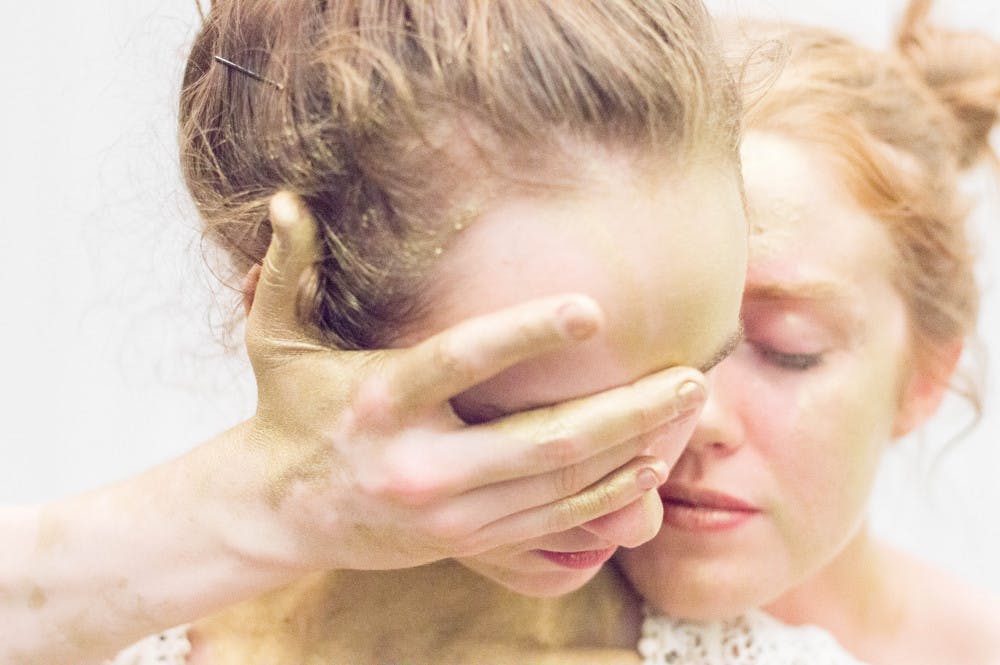
The evening of Oct. 14 will feature several unique but cohesive performances. Before we mothernaked fall is choreographed by Visiting Assistant Professor of Dance, Scotty Hardwig, and explores the poetic processes and expressionist sensibilities of poet Dylan Thomas. Meanwhile, This is your Paradise, a composition by Salt Lake City-based dance artist Molly Heller, confronts struggle, resistance, hope and faith. “A Duet Called Blue” is a collaboration between Heller and Hardwig that follows the creation, disconnection and cracking undercurrent of energy that runs beneath the sea of human sensation.
Before we mothernaked fall references Thomas’s interest in the male form and its place in the world. Hardwig adapts the sentiment for modern times by sketching the homosensual body in an attempt to create a space “where the individuals identity melts into a group body,” according to dancer Doug LeCours ’15.
“It’s not about sex or identity but sensation, a shared sameness among the three bodies on stage moving through a physical experience together,” LeCours said.
LeCours will return to campus as one of the piece’s three performers. Noting that he has always had a strong advisor-advisee relationship with Hardwig, he is proud to make his professional debut at the College.
The sound score from the performance features text by poet Dylan Thomas. Unlike contemporaries such as T.S Elliot and W.H Auden, who focused on specific social and intellectual issues, Thomas is celebrated for writing that is emotionally lucid yet narratively obscure. By conveying the feeling of his subject more clearly than its definite form, his work possesses a quality that corresponds naturally with dance. Thomas’s storied life funnels into often-metaphysical idolatry, with a percussive rhythm that hammers lines in time with the reader’s heart, covering topics ranging from death to the human condition to lost childhood and the sea of coastal Wales. Hardwig played his works aloud as they worked to generate content, drawing from both his delivery and subject.
Both Hardwig and Heller have unusually organic and communicative creative processes, in which the final performance evolves organically from a continual dialogue between dancer and choreographer. Heller views the process as collaboration, both in terms of movement and the exchange of energy. A successful project invokes a strong sense of catharsis.
“Choreography helps me understand that I’m not any label; I’m no perimeter, I’m no thing. I am experience,” Heller said. “I actually believe that we are our experiences. The energy produced by a situation translates into our body and it’s felt and it’s manifested physically and we are those things, so we are our DNA and we are also our experiences. Identity is our way of negotiating those two things.”
Heller works and studies in Salt Lake City, UT, where she uses dance as a medium for healing. Her movement seeks to mend trauma through a heightened awareness of energy channeled through the physical body. Supported by Zen beliefs surrounding introspection and mindfulness, she also operates a teahouse, with the goal of supporting the individual within a greater community.
Her research into the healing powers of dance is interwoven into her pedagogical beliefs. The differences between her passions – dance and tea culture – allow her to expand the ways in which she perceives the world and to further appreciate ritual, sacred spaces and inner stillness.
This particular performance is bursting with a passion so potent it is felt tangibly amongst the audience. Explicit consciousness on behalf of onlookers or the dancers only impedes the journey to the liberation that this raw expression allows. Instead, the audience is encouraged to relax their minds and embrace the stillness of honest movement.
The first performance will begin at 7:00 p.m. on Oct. 14 in the Mahaney Center for the Arts. All performances are free and open to the public.
Arts Spotlight: Performing Arts Series
Comments


