
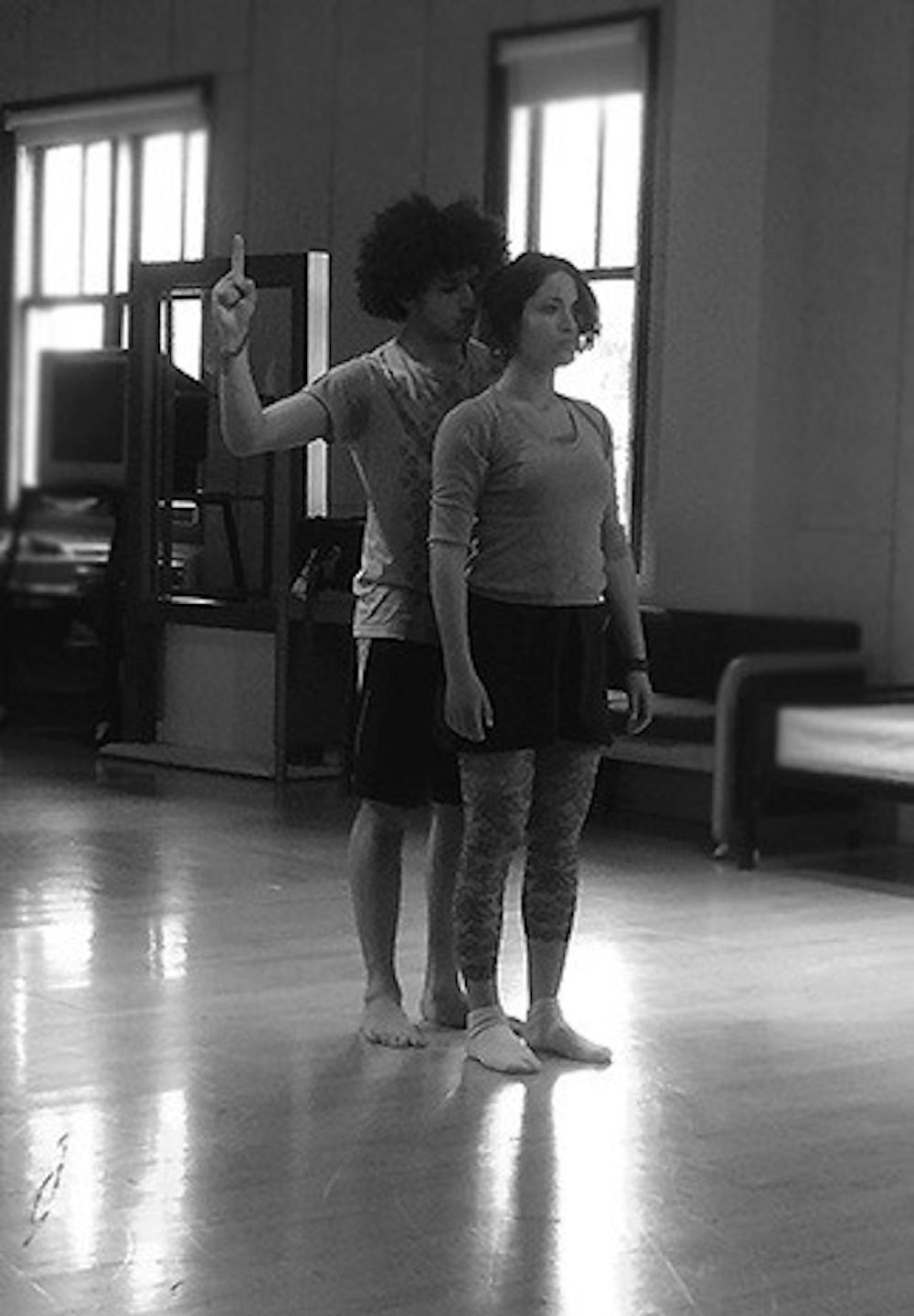
This Friday, Miguel Castillo ’17.5 and Lorena Neira ’17 use simple, deliberate movements to enact a wordless drama that evokes some of the universal truth we see etched across the history of the world. Together, they will stage a performance that offers visceral interpretation of the timeless idea of Axis Mundi. Traditional depictions often render humankind in the center of a continuum with concentric circles blossoming out to encompass all spheres from the netherworld to the celestial.
Directed by Visiting Assistant Professor Jonathan Vandenberg, this piece also represents an intense interdepartmental collaboration where Dance and Theater as well as the Middlebury Museum have come together to create something quite special.
The performance will take place in the largest gallery of our museum on Friday at 11 p.m. and Saturday at 1 p.m. Friday’s showing is followed by an “Off the Wall” Lunch and Discussion at 12:30 p.m, moderated by dance artist in residence Scotty Hardwig with the collaborators. Lunch is provided and the event is entirely free to College ID cardholders.
Axis Mundi is simultaneously very nebulous and very concrete. To get to the root of the performance, I had the privilege of posing Professor Vandenberg some questions.
Middlebury Campus (MC): What does Axis Mundi mean to you?
Jonathan Vandenberg (JV): Well what’s interesting about the idea is it’s in many different traditions, it’s not just a western idea, it’s both eastern and western … It’s a liminal space in which there is a fluid gateway between two different realms, an upper and a lower. In many cultures this is manifested in a number of ways. There are geological representations of Axis Mundi such as Mt. Fuji.
There is a long tradition of painting this realm, depicting the gateway between the celestial sphere and the terrestrial sphere. We see the earth as a microcosm and the macro in the universe, the infinite. And what is really interesting is that the human body appears in so many of these maps, as if the human body is another concentric sphere. The human body, the earth, the heavens.
Ultimately it’s a very anthropocentric view of the world, that the human body is a microcosm of the infinite.
MC: What was your creative process like?
JV: For me, the axis mundi is appealing for two reasons. First and foremost because it is a very universal idea, it isn’t tied to a specific culture. In theater, I am always looking for a universal language, something that applies regardless background or culture
Secondly, I’m very drawn to the polarity. In the piece you have on one hand love and hate, eros and thanatos, you have earth and you have death. The dual nature of the axis mundi becomes part of the dramaturgy of the piece.
MC: So is that the connection to dance? That the body can transcend and walk amongst these levels to some extent?
JV: I hesitate to use the word dance because I don’t think of it as a choreographic piece but it definitely has dance like elements because it exists in a world that is just human movement. It seems to be a really natural form for the idea because first and foremost, all these diagrams and paintings and images are two-dimensional and I wanted to figure out how we could do it in three-dimensions. It would be impossible to create a diagram of a three-dimensional axis mundi but using the body allows us to begin doing just that.
MC: What has it been like working with Lorena and Miguel?
JV: It has been very collaborative. I definitely had some ideas when I began but then we worked very organically. We started three weeks ago, meeting once a week to develop a vocabulary of movement and have taken it from there.
They have contributed so much; it would never be the piece it is without their bodies. They found solutions to the ideas that I brought. In many instances they made discoveries; it became a kind of research. Their feedback and comments has been vital to the development of the piece. They have an incredible chemistry that saved me a ton of time. We did some exercises in the realm of what we would call “durational performance” because it’s an endurance piece, to perform this for one hour. They move at a very deliberate pace for one solid hour and it’s very physically rigorous, very demanding, very mentally demanding. I could not have done with without those two specific people.
MC: Is there an overarching relevancy or connection to our everyday life at Middlebury?
JV: In a way, this points out in our quotidian lives there’s also something we’re part of in a larger context. It takes time in a very different way and reminds us that every body is valuable, every individual is valuable and in that regard, everybody is worth seeing on stage. I also think of it within the concept of time, it exists outside of time because it’s a loop, there is no beginning or end.
I like the idea that we’re coming in an disrupting everybody’s perception of time. It’s so hard for us in our daily lives, we’re passive spectators all of the time to government, to politics, to advertising, to entertainment. We’re constantly being told what to think. In work like this you have to be an active spectator. The piece is a kind of multivalent, universal language that you project on to. It becomes like a dark mirror, you see it and then read into it through your own personal history and in doing so, you see yourself.
Arts Spotlight: Performing Arts Series
Comments


