4.b-tuneyards-color
(10/25/18 9:57am)


Use the fields below to perform an advanced search of The Middlebury Campus's archives. This will return articles, images, and multimedia relevant to your query.
1000 items found for your search. If no results were found please broaden your search.


Middlebury women’s soccer fought valiantly in the final stretch of the season, and suffered the team’s first loss of the season with Tuesday’s final game against Williams. The Panthers managed to win both games on the weekend of Oct. 13 and 14. The victories boasted equally impressive scores, when Middlebury crushed Trinity 4-1 and then followed up that performance with a five-goal shutout against Wesleyan. This past Saturday, Oct. 20, the Panthers played Bates at home for Homecoming Weekend. Like many of Middlebury’s previous opponents, Bates was unable to contain the blue and white. Middlebury won 3-1. Sophomores Maggie Moskun and Eliza Van Voorhis and junior Sabrina Glaser each put one in the net for Middlebury. The goals helped the Panthers rally for the win despite an early goal from Bates. The weekend brought much excitement, many alumni and even more fans. “We draw on energy from each other during the games but more important we draw on energy from the fans,” said senior captain Amanda Dafonte. “We have had so many amazing supporters coming out with signs and cheering loudly [regardless of weather]. It gives everyone such a great boost and makes that run that seems impossible possible.” “We have had an amazing season and owe it to ourselves to finish the regular season the way we started it — with wins,” continued Dafonte. “Our motto this season has been ‘one game at a time.’ We never look back at what we’ve done and we never look past the game right ahead of us. Every single team in the NESCAC is competitive and every game is a challenge.” Where Middlebury came up short, unfortunately, was their final game of the regular season against their Route 7 rival, Williams College. After a hard-fought battle, Williams emerged victorious, 0-1. The match was predictably close, since the Ephs were ranked third amongst Division III women’s soccer teams, and the Panthers fifth. Although Middlebury outshot Williams 9-4, the Panthers had trouble connecting the ball to the back of the net. Goalie Eva Shaw made one save, while the Williams goalie, Olivia Barnhill, made five. The Panthers also had a chance to tie the game in the 78th minute, when Ellie Greenberg ’20 received a pass from Virginia Charman ’20 in the box. Greenberg’s shot was then denied by Barnhill. Women’s soccer’s loss was the first of its season, and will finish the regular season with a record of 13-1-1. The team will begin the NESCAC tournament this Saturday as the second seed, playing seventh seed Bowdoin at 12:30 p.m.
Women’s tennis ended their fall season with a bang at their home invitational on the weekend of Oct. 13. Over the course of three days, Middlebury hosted the Brandeis and Williams women’s tennis teams, and the Panthers ultimately demonstrated strides in their doubles play. Competition took place inside the Nelson Recreation Center, where the Panthers played four to five singles matches and three doubles matches against each team. The singles matches were played in the traditional best two out of three format, with a tiebreaker set for the third. The doubles matches consisted of one pro-set. In spite of injuries and study-abroad trips plucking away at the team’s depth, the Panthers managed to come in swinging for their Friday’s evening doubles match. Sophomore Ann Martin Skelly and senior Christina Puccinelli edged the Williams duo of Chloe Henderson and Emily Zheng, 8-5. “Historically, Williams has been quite the rival for us, but all that has done is pushed us to be better year after year,” said Puccinelli. She especially feels confident in the team’s ability to match Williams in the event they face one another in this year’s NESCAC finals. This fall, Middlebury spent time focusing on doubles training, where they worked to attack early in on matches and to execute bigger moves at the net. The team’s hard work continued to show throughout the weekend, when they posted victories in three out of four matches on Saturday. In Saturday’s doubles matches against Brandeis, Skelly and Puccinelli were once again a force to be reckoned with, as they defeated Olivia Leavitt and Lauren Bertsch (8-3). Nora Dahl ’22 and Emily Bian ’21, meanwhile, clinched an 8-3 win against Sophia He and Ana Hatfield. Spirits were high across the board, and the team’s unwavering positivity gave them momentum for the rest of the weekend’s matches. “Our opponents could constantly hear us cheering on one another from across the courts,” said Bian. “Even when we were down in our respective matches, you couldn’t tell. There was always someone pumping you up.” In Saturday’s singles matches against Williams, Puccinelli claimed a 6-3, 6-3 win over Henderson, while Emma Gorman earned a hard-fought 4-6, 6-4, 11-9 victory against Maxine Ng. Later in the day, Gorman cruised over He (6-3, 6-1), while Skelly defeated Michele Lehat in straight sets (6-3, 6-3). Dahl dropped just three games in a 6-3, 6-0 triumph over Isabel Cepeda. On Sunday, Middlebury competed against Brandeis in both singles and doubles. Skelly and Puccinelli picked up an 8-1 victory over Bertsch and Leavitt, while Bian and Dahl won 8-6 against Khromchenko and Lehat. In singles, Puccinelli knocked off Leavitt in straight sets (6-0, 7-6 (4)). Gorman earned her third singles win of the weekend, with a 6-3, 6-3 victory over Khromchenko. Looking confidently towards the spring, the Panthers will continue to train intensely, and await five juniors returning from study abroad. “In the spring, it’s really going to be about coming together again as a whole team of eleven instead of the six of us we had in the fall,” said Puccinelli. Until then, the primary focus remains on capitalizing on the growth they saw this fall. Their sights are set high; they want to clinch the team’s first national championship.
After weeks of anticipation and hard work, the NESCAC Championships are on the horizon for the men’s and women’s cross country teams. The Panthers’ most recent meet was the Connecticut College Invitational on Saturday, Oct. 13. At the meet, the men were able to obtain third place in a field of 27 teams. They had a score of 96, while Amherst came in first with 72 points and Williams came in second with 76 points. The top three runners for the Panthers were Matt D’Aquila ’21, who placed seventh, Theo Henderson ’20, who placed 10th and Henry Fleming ’20, who placed 15th. D’Aquila finished in a time of 25:09.0, Henderson finished in 25:19.7 and Fleming finished in 25:23.4. “As a whole, both the women’s and men’s cross country teams did a great job at Conn,” Rory Kelly ’19 said of the Panthers’ performance at the meet. “The women’s team had a particularly strong day as we came away with the win, beating strong competition. I was overjoyed with my performance and even more so for our team win. It was a great day for us.” With a score of 67, the women captured first place in a field of 25 teams. Kelly was the top runner for the Panthers, and she came in fourth place with a time of 21:38.2. Next up for the Panthers was Cassie Kearney ’22 with a time of 22:07.5 which got her seventh place. Then came Tasha Greene ’21 in 14th place with a time of 22:19.0. “I think that going into the race, our strategy was to not be afraid to push ourselves and to trust in the training that has built us up to be this strong at this point in the season,” Kearney said when asked to describe the women’s race strategy. The Panthers will be competing in the NESCAC Championships on Saturday, Oct. 27 at Franklin Park in Boston. If the team competes as hard as they always do, they should be able to make a statement at the championships. “We are very excited for NESCACs,” Kelly said. “This race is a major culmination point in our season. In terms of preparation, we are getting our bodies and minds rested and ready to throw down.” Additionally, Kearney said, “I think collectively we share a really positive mindset going into NESCACs after last week’s win. We’re getting so much stronger each week, so I’m super excited to see how we do next Saturday at Franklin Park.”
“A little irresponsible” is how Film and Media Culture Professor Ioana Uricaru describes her decision to move to the U.S. in 2001 to study film and television production at the University of Southern California. She did not have any friends or family in the U.S., and naively she thought the university would provide housing for her. Moreover, she did not have the money to pay for the expensive program. Luckily, she found a room to rent online while she was still in Romania, her home country. She became friends with the landlady Tracey, who picked her up at the airport three days before school started, and stayed with her for a couple of years. During her first year in Los Angeles, Uricaru sometimes found herself in a far from ideal situation. At some point, Tracey told her that she had to make lemonade, because “when life gives you lemons, make lemonade.” That is where the name of Uricaru’s debut feature film comes from. “Lemonade” centers on Mara, a 30 year-old Romanian immigrant and single mother working on a temporary visa in the U.S. who marries an American man. When she applies for a green card, things start to become difficult, and she is forced to confront various obstacles. “I wanted to make a film about a Romanian woman who immigrates to America, because that’s what I know,” Uricaru said. “That’s what I lived through.” When she heard the overly-optimistic American expression that seems to suggest any trouble can be turned into something positive, she was puzzled and found it “really stupid and almost offensive.” Later, she started to realize that the idea behind the saying is one deeply rooted in American culture — the belief that one can always find a way around hardships as long as one makes the effort. Yet that may not be totally aligned with reality, as the challenges faced by Mara in the film show. Uricaru’s own story as a filmmaker and an immigrant perhaps can be seen as one of making lemonade out of lemons. Her father is a writer, her mother teaches Romanian, and Uricaru grew up in Cluj, a city in Transylvania, in a house full of books and a love of literature and fiction. At the same time, she grew up under the Communist dictatorship of Nicolae Ceaușescu. Control over media is just one of the many repressive aspects of the totalitarian regime, and going to the cinema to watch movies became one of the very few things that Uricaru enjoyed and needed in order “to escape the bleakness of everyday life.” The reality of the dictatorship also influenced Uricaru’s choice in what to study in university, and she considered the range of options to be very narrow. “A lot of possibilities were just out of the question, because many of the humanities were not just ideologically influenced, but [also] ideologically controlled,” she said. “You couldn’t do literature, or history, or philosophy — anything like that — and have a good feeling about it.” The sciences were what remained. For young Uricaru, going to a large city after university to work was also important. A degree in science and a potentially high-level research job in laboratories seemed to be the way to achieve success in Communist Romania, where the government would assign graduates their jobs. Uricaru graduated from University of Bucharest in the Romanian capital with a Masters of Science in Biochemistry. The degree, however, did not land her a job in a lab. When she was still a student at the university, violent demonstrations against the totalitarian regime led to the overthrow of the government and the execution of Ceaușescu, ending the 42 years of Communist rule of Romania. What followed was a painful transition to capitalism and democracy. “Although I was a student in biochemistry, I felt that this is the last chance that I have to maybe do something else,” she said. “So I started thinking about it, and I realized that I still wanted to do film.” The only film school in Romania, National University of Theatre and Film, was harder to get in than one might imagine. The school would only accept about seven students each year for the directing track, and there was a rumor that only those with private ties could get in. Despite not knowing anything about film production, Uricaru believed it was the last chance that she had to pursue her passion. She took the admissions test twice, first when she was still in her fourth year of the biochemistry program, then when she had finished her science degree. She compared the test to the kind of reality television show in which people try to survive on an island. It was probably a little less dramatic, but there were multiple rounds of stressful competition over the course of one week that eliminated the number of applicants from 120 to seven. “I thought … if I don’t get in the second time, then forget it, I’m just going to become a scientist,” she said. “But I did get in the second time.” The offer was not something she could turn away, and she started her journey toward becoming a filmmaker. Later, she continued her studies at USC and paid for the tuition herself through — unexpectedly but perhaps not surprisingly — a teaching assistantship in the university’s biology department. “So in the end, it was good that I did the degree in biology. It was useful,” she said, laughing. It was also useful in the sense that filmmaking is as much a process of artistic creation as analytic, scientific organization. Uricaru possessed skills and experiences for both, and the duality of their combination resonates with both “Lemonade” and her identity. “Lemonade” is a Romanian film and is mainly produced by a Romanian company, while it is also set in the U.S. and focuses on this country of immigrants, making it somewhat similar to an American indie film. “I’m now a permanent resident, so I’m kind of an American now too. And if I ever get an American citizenship, I will keep my Romanian citizenship,” Uricaru said. “So I’m going to always be both. I like the film to also be both.” The film depicts the struggle of balancing two identities as an immigrant in the U.S., and the events in it all came from real-life stories that Uricaru gathered through extensive interviews with young Romanian immigrants with children. They told her different stories, but all of them expressed a similar sense of “ambivalence between what they left behind and the new country.” Uricaru found that they somehow saw themselves as “the sacrificial generation,” and that they were doing everything for their children, who were either born in the U.S. or came here early on. The immigrants she interviewed had some discoveries of their own, too. When she told them that she was looking for a little boy about eight or nine years old, who speaks Romanian to play Mara’s son character in the film, they all responded that their children could speak Romanian, which turned out to not be the case when she met the children. “The parents lived in this kind of illusion almost, because they spoke Romanian around the house, [and] the child seemed to understand, but actually the child didn’t speak it,” Uricaru explained, adding that many parents had since told her they started to try encouraging their kids to speak the language more. Uricaru was interested in this feeling of not fully belonging in either place and the constant self-questioning of whether the decision to emigrate was a good one. As for herself, she found it difficult to tell if that is something she still wonders about. What was more important was that she make a “very conscious effort” to spend time in Romania and do work there so that she stays in touch. If the style of her film can be an indicator of whether or not she has stayed in touch, it seems that Uricaru has. According to media production specialist Ethan Murphy, “Lemonade” is “very much in the style of new wave Romanian [cinema].” One of the film’s producers is Cristian Mungiu, an established Romanian filmmaker whose achievements include a Golden Palm at the Cannes Film Festival. Mungiu is among a group of new Romanian filmmakers who have been exceptionally well-received in the last 15 years. To show me the Romanian films she considers to be masterpieces during our interview, Uricaru stood up from her office chair and reached for a few DVDs, including “The Death of Mr. Lazarescu” (2005) and Mungiu’s “4 Months, 3 Weeks and 2 Days” (2007). The films have come to represent what people call “Romanian minimalism” — the idea that the individual story and detail of everyday life are emphasized, as opposed to the focus on the national and the collective under the Communist regime. “It’s really a contagion,” she said, referring to the filmmakers who continue to produce excellent films. “So I’m very proud to be a Romanian filmmaker at this time, I think it’s great.” In the one-hour talk with Uricaru in her office in Axinn, the fact that she is a professor dedicating a lot of of her time teaching two classes in one semester almost faded into the background. Finne Murphy ’19 is an English major taking Uricaru’s screenwriting class, and she appreciates how hard she pushes students to make their screenplays even better. Murphy, not unlike Uricaru, grew up with a writer father. “[My father] has a MFA in screenwriting, so my whole life he has been writing scripts. I grew up learning it, but I’ve always wanted to write fiction,” Murphy said. “But since being in this class, I kind of wish I was a Film and English double major, or that I had started this sooner.” This is now Uricaru’s seventh year at Middlebury — producing “Lemonade” took eight. She shot the film in Canada during her year on sabbatical and completed the post-production while teaching, flying to Europe during one semester, Thanksgiving and winter breaks. After its Canadian premiere in Montreal (where it was also shot) this week and before its Romanian premiere next week, “Lemonade” will reach Middlebury audiences as well. The film will be screened this Saturday as part of the Hirschfield International Film Series. Uricaru and Mălina Manovici, who plays the film’s protagonist, will be in attendance for discussion after each screening. The film will also be shown in Burlington on Oct. 18 at the Vermont International Film Festival. Editor’s note: Finne Murphy is an Arts & Academics editor.
With family and friends cheering it on, the Middlebury field hockey team extended its streak to 10–0 on Saturday, beating the Tufts Jumbos 2–1 in overtime. The Panthers took the lead after just four minutes of play, when junior Marissa Baker scored as part of a penalty corner. Tufts managed to tie it up about 20 minutes later, also on a penalty corner. The game was incredibly tight for the remainder of regulation time, with Middlebury marking just five shots on goal compared to the Jumbos’ three. “We spend a lot of time watching film to understand our opponents’ strengths and weaknesses,” said defender Olivia Green ’20. “For Tufts, we knew that they set their press high, meaning they pressured us when we tried to advance the ball from our defense to our midfield. We responded by playing fast, keeping the ball moving and tiring out their forwards by making them run.” BENJY RENTON/THE MIDDLEBURY CAMPUS The high-pressure game was the first time Middlebury was forced into overtime, a scenario the Panthers work on a lot in practice. When the final whistle blew, they knew what to do. “When the clock ran out we got in our huddle and Grace [Jennings] said, ‘this is our ish!’,” explained goalkeeper Megan Collins ’18.5. “We know that OT lends itself to our way of playing — it stretches the field out so that we have more space to keep possession through long passes and gives us an opportunity to play our game.” The Panthers’ preparation certainly paid off, as sophomore Erin Nicholas found the back of the cage just 1:15 into overtime, for her sixth goal of the season. “The interesting thing about this game is it was the first time that we played really well and we still had to fight for that outcome,” said senior captain Grace Jennings. “It really challenged things that we thought we had figured out and showed us what else we have to work on moving forward. We realized that there is another level that we have to get in order to accomplish our goals for this season.” Despite the challenge, the Panthers proved once again what they are capable of when they work as a team. Middlebury also bested Rensselaer Polytechnic Institute 4–0 on Tuesday, Oct. 9. Up next, the Panthers will take on Trinity this Saturday, Oct. 13 during Fall Break.
The hearings and subsequent confirmation of now-U.S. Supreme Court Justice Brett Kavanaugh sparked national outrage that resonated with many members of the college community over the past two weeks. Across campus, students and faculty publicly expressed their support for Dr. Christine Blasey Ford and survivors of sexual assault with signs, a “Walkout Against the Patriarchy” and chalked messages on pathways. Signs Supporting Survivors “WE BELIEVE SURVIVORS,” declared signs that surfaced across campus after the tumultuous Senate hearing addressing Dr. Ford’s sexual assault allegations against Justice Kavanaugh. The lead organizer of the postering campaign, who requested anonymity given her probation status from the Charles Murray protest, printed several posters and emailed the PDF file of the posters to multiple co-activists including Grace Vedock ’20 and Taite Shomo ’20.5. “I wanted to do something to help make women and survivors feel supported on this campus. To help them feel heard. Believed. Safe. They were my motivation,” the student wrote in a message. “Beyond campus, my sisters were my motivation. My mom. My friends. My future nieces.” However, responses have not all been positive. Certain signs, such as one posted outside of Proctor Dining Hall, were almost immediately ripped down. Throughout the next few days, additional signs were vandalized and restored. Soon after the initial incident, the Community Bias Response Team (CBRT) weighed in, condemning the vandalism in an all-school email and noting that it violated “the general principle of respectful behavior and community standards.” A similar action took place outside the suite of Juliana Dunn ’19.5, Vee Duong ’19 and Nathan Nguyen ’19. In a Facebook post, Dunn shared that a student continued to erase the “WE BELIEVE CHRISTINE” text on the whiteboard outside their suite and remove similar paper signs. As of Tuesday evening, the messages had been collectively vandalized nine times. [pullquote speaker="" photo="" align="center" background="on" border="all" shadow="on"]Supporting survivors should be the norm, not a radical act.[/pullquote] “As a suite we are unsurprised but still stung by the ripping down and erasing of our signs of solidarity; it felt particularly painful to those of us who are survivors,” the suite members collectively wrote in a message to The Campus. “Supporting survivors should be the norm, not a radical act. We want to expect more of our peers and the institution, but our experiences on campus have largely taught us to prepare for less.” The primary organizer of the poster campaign also wrote “BELIEVE SURVIVORS” on the chalk message board next to the mail room, including the hotline for WomenSafe (800-388-4205). Throughout the twenty-minute setup process, dozens of women stopped to express their gratitude and identify themselves as survivors. Protest Against Patriarchy A “Walkout Against the Patriarchy” started small but grew to a crowd of about 40 professors and students outside of Proctor on Oct. 4. Participants gathered in front of the steps to the dining hall with signs protesting Justice Kavanaugh’s nomination and many passersby joined in after seeing what was occurring. The mood was somber. Participants expressed their frustration at the Republican Party’s continued support of Justice Kavanaugh despite the accusations of sexual assault, and shared their belief that recent events put women across the nation at risk. Many said they were afraid that Justice Kavanaugh’s confirmation to the Supreme Court would threaten the right to abortion protected by Roe v. Wade. Participants also discussed concrete ways to make a difference, such as voting and talking about uncomfortable issues with family members and friends. Some suggested that to create change, they would need to look outside of the “Middlebury bubble” and engage with the world at large. The professors in attendance hoped that their students and their students’ generation as a whole would work hard to protect sexual assault survivors and improve the lives of all women. Gender Studies professors Laurie Essig and Sujata Moorti, Writing and Rhetoric professor Catharine Wright and Director of Chellis House Karin Hanta arranged the event with help from other faculty members. “It was last minute,” Essig said. “We got some posters up and put it on Facebook on Wednesday, the day before.” “I just happened to stumble upon the protest on my way home and stayed a bit to hear people’s thoughts and responses to the situation,” Melisa Topic ’19 said. “I appreciated the mixed student-faculty attendance because I believe it showed both unity and support from all sources on this campus, and demonstrated the diversity in individuals that are feeling some type of way about the Kavanaugh nomination.” The next day, Feminist Action at Middlebury (FAM) and the Student Government Association (SGA) encouraged students to participate in a “blackout” by wearing black to show support for survivors of sexual assault and for Dr. Ford, Ramirez and Swetnick. On Saturday, the Senate voted 50-48 to confirm Justice Kavanaugh to the Supreme Court. He was sworn in later that day. Chalk in Solidarity Using a rainbow of chalk, students scrawled messages of frustration, despair and support in response to Kavanaugh’s confirmation. Some of the messages were longer: “Men Need to Hold Other Men Accountable” and “Age Does Not Excuse Assault,” while others were simple and impactful: “Believe Survivors” and “We Believe Dr. Ford.” The chalking was organized by Taite Shomo ’20.5 and executed on Monday and Tuesday. “I happen to believe those allegations, but his appointment to the Court is much larger than just him. It’s a symbolic message to survivors of sexual assault and abuse that our experiences don’t matter,” Shomo said. [pullquote speaker="Shomo '20.5" photo="" align="center" background="on" border="all" shadow="on"]The idea that a person can inflict something so painful and traumatizing on another person with no consequences is devastating.[/pullquote] “I was assaulted when I was 13, only a little younger than Dr. Ford when she was assaulted,” she said. “The idea that a person can inflict something so painful and traumatizing on another person with no consequences is devastating.” Shomo wonders if she, or other survivors at Middlebury, may someday have to experience what Dr. Ford has gone through, and if they do, whether their story will even matter. “Chalking campus felt like a cathartic and immediate way to channel some of the anger and sadness I’ve been feeling since Kavanaugh’s appointment in a constructive way” she said. The purpose of the chalking was not only personal expression. Shomo also hoped to send a message to both survivors and assaulters on campus. “There are people here who care about what survivors have been through and care about assaulters being held accountable for their actions — even if those actions took place in high school or college,” Shomo said. Shomo described one moment of the chalking that was particularly rewarding. As she and her girlfriend were writing in front of Proctor, a student walked up to them and asked to borrow their chalk. The student scribed two powerful words: “Me Too.”
Mail center employees processed almost 4,000 more packages this September than they processed in September 2017. The number of packages that the mail center receives has grown steadily over the past decade. Yearly totals were in the fifty-thousands from 2009 to 2012, and then increased in 2013 to approximately 70,000 packages — a 24 percent jump. Between 2014 and 2017, totals climbed from about 80,000 to roughly 89,000. If this September is any indication, the 2018 annual total will easily surpass 90,000 packages. Many Middlebury students, including some student mail center employees, attribute this semester’s surge in packages to the bookstore’s decision to contract with online bookseller MBS Direct instead of selling books in the physical store. Jacki Galenkamp, the mail center supervisor, agreed that the influx of packages this September was partially due to an increased number of online book orders. [poll id="1" align="center" background="on" border="all" shadow="on"] “We were getting quite a few books that were meant for the bookstore,” she said. All United States Postal Service (USPS) shipments arrive at the mail center, Galenkamp explained, and since most books ordered after the start of the school year were sent through USPS, the mail center bore the brunt of the work. “We processed them for about two weeks maximum and then I ended up calling the post office and having them sort out what was addressed to 58 Hepburn, the bookstore’s address,” Galenkamp said. But Galenkamp does not believe the bookstore is solely responsible. “I can’t say with any kind of certainty say how much the bookstore affected us,” she said. “It definitely did affect the number, but I don’t know how much.” All MBS Direct packages were delivered by USPS, and USPS packages accounted for only about 40 percent of this September’s 4,000-package increase. Because the bookstore no longer sells physical books on campus, students have started buying nearly all of their books online, whether from MBS Direct, Amazon or other sites. “People order from ThriftBooks, Book Depository, Amazon rentals. There are so many companies,” said Nicole Duquette, one of the mail center’s two full-time mail clerks. [pullquote speaker="Rachael Salerno '18.5" photo="" align="center" background="on" border="all" shadow="on"]The transition from a physical bookstore to the online bookstore just means that everyone and their mother’s uncle is trying to get their books from the mail center.[/pullquote] “The transition from a physical bookstore to the online bookstore just means that everyone and their mother’s uncle is trying to get their books from the mail center,” joked Rachael Salerno ’18.5, a mail center employee. The surge of packages made the last month a challenging time for mail center employees. “During September we were working seven days a week, we were staying late, we never closed the window until the last person was helped,” Galenkamp said. “And then after we closed we would stay for an hour, two hours, as late as our personal lives would allow.” According to Galenkamp, employees were so swamped on some nights that they were unable to process everything despite staying late after work. “It was really hard for us to walk out the doors without having finished everything, and we would come in early the next day. That was a little bit of a struggle.” The number of packages also made it harder for employees to find specific items during peak pickup times between regular morning classes. “We don’t want it to be a long and arduous process for students, but with the number of packages that are there all the time, it’s been increasingly difficult to find the number of packages right away,” said Mattea Preece ’19, another student employee. “It’s really hard because you’re trying to keep the students as happy as possible. Obviously you want to find each package, but sometimes you have to disappoint one student,” Preece said. For the most part, students were patient during the September package rush. “Students went out of their way to thank us and we really appreciate that,” Galenkamp said. “We worked non-stop, leaving at the end of the day and working weekends, and students were really understanding.” “The good times definitely outweigh those bad and awkward encounters that you have,” Preece said. “I just think a lot of students aren’t used to having to wait for their packages. I have had a few students be rude to me, and I’ve heard stories from other employees as well, but I understand why people are frustrated.” Students can help the mail center function quickly and efficiently by respecting the center’s policies. “One of the biggest things that students can do is not come down until they get an email from the mail center saying that their package has arrived,” Galenkamp said. “It wastes their time because they’re waiting in line, it wastes our time because we have to stop processing in order to tell them that their package hasn’t been processed yet.” Galenkamp said it could be helpful for professors to consider switching to e-books, and employees have ideas for ways to redesign the mail center to maximize efficiency. “It would probably speed up the lines so much more if we had an extra window or if they just expanded the counter space. Then we could all be working together to make sure that we got the lines cut down,” Preece said. Galenkamp’s ideal mail center would be bigger and able to accommodate oversized items with a larger window. However, she is unsure if it would be cost-effective to renovate the center only to cope with the three busiest weeks each year. “If you could convince the town to put in a Target, that would help us a lot,” Galenkamp laughed.
ADDISON — The 17th annual Dead Creek Wildlife Day kicked into gear early on a gray and hazy morning. Blue skies arriving around mid morning on Saturday, Oct. 6, turned the day into one of the more beautiful ones the event has seen in recent years. Largely community-centered and family-oriented, the event is held each year at Dead Creek Wildlife Management Area off Route 17 in Addison, Vermont with the mission to educate, inform and encourage environmental and wildlife awareness. Two large striped tents set up in the center of the event housed informational booths for an array of organizations. Activities offered included face painting, decoy carving and blue bird box building, while wildlife demonstrations occurred in the surrounding area and information sessions were held in the Dead Creek Headquarters. [pullquote speaker="WARREN KING " photo="" align="center" background="on" border="all" shadow="on"]Our goal is to sensitize people… by exposing them to a wide variety of activities for all ages.[/pullquote] Dead Creek Wildlife Day represents the organizational efforts of Warren King, Amy Alfieri and Nicole Meier, among others. They hope to emphasize the importance of getting outside and interacting with the environment and all it has to offer. “Our goal is to sensitize people… by exposing them to a wide variety of activities for all ages,” said King, a conservationist and founding board member of Audubon Vermont, who has helped organize this event since its inception. He highlighted the importance of making more people aware of the wildlife resources available in the Champlain Valley. An announcer outlined activities occurring every 30 minutes in order to feature all of the resources and their representation at the event. The Vergennes Boy Scouts provided food and further entertainment for attendees with a snack tent and raffle. All proceeds went to the organizations in attendance. Veterans of Dead Creek Wildlife Day have their favorite activities.“We always go straight to the blue bird box building,” said one family who had been attending for the past four years. “It’s my daughter’s favorite part of the day. We make one or two every year and now we have so many that we’re going to start giving them to friends!” [gallery ids="40614,40689"] A giant semi-circle began gathering at around 10 a.m. for the Warden Dog demonstration to watch Crockett — a Labrador retriever — track human scent. One of the most popular events for the past 10 or so years, this demonstration displayed the interactive nature of the event. In addition, a representative from the Southern Vermont Natural History Museum gave child-friendly talks, including displays of critters ranging from falcons to turtles, from 11 a.m. to 4 p.m., making clear the passion and dedication for wildlife education and awareness held by all of the volunteers and presenters. While the event is catered towards families, there have been efforts each year to expand its offerings. Alfieri, the manager of Dead Creek Wildlife Management Area, explained that new activities have been added to keep up interest and provide more options for the “diverse crowd” and its “diversity of interests.” This year such activities included “Operation Game Thief Trailer,” “Beavers: A Sentry to Biodiversity” and “See it. Sketch it. Bird it.” Jeff Whipple, a game warden from Orange County, was thrilled with the turnout. His project, the Operation Game Thief Trailer, displayed examples of anything involving illegal wildlife, including a photo with information about infamous poachers in Vermont and an $8,000 gun used in an illegal killing. Whipple does five to six events with his trailer each year, but said that the number of people at the Dead Creek Wildlife Day surpassed that of all of his other events. His goal with each event is to highlight illegal poaching and to make clear its perverse effects to hunters and non-hunters alike. “We’re really trying to pull on people’s emotions,” he said. [gallery size="full" ids="40675,40620,40678,40632,40682"] Several Middlebury College students also attended the event, some of whom brought their families for a Fall Family Weekend affair. “The best part was being able to connect with the local environment through all the activities and getting a better sense of the place we live in,” said Jacob Freedman ’21. In particular, he enjoyed seeing the “infectious smiles [of the] young kids holding a purple finch and chickadee during the Bird Banding Demonstration.” About a 15-minute drive from Middlebury, the event is an ideal getaway for students and families in the area. King appreciated the presence of a handful of students and said if he were to have it his way, Environmental Science professors at the college would make the event mandatory, or at least recommended, in the coming years. [pullquote speaker="JACOB FREEDMAN " photo="" align="center" background="on" border="all" shadow="on"]The best part was being able to connect with the local environment through all the activities and getting a better sense of the place we live in[/pullquote] “It has become increasingly important today to provide opportunities for people to interact with and learn about the environment,” said Alfieri. And that is exactly what this event strives to do. Bringing together people from the Addison County community as well as surrounding areas of Vermont and New York to, Dead Creek Wildlife Day aims to raise awareness and create a community of people who appreciate the outdoors.
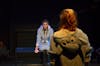
The cast of “You Are Here,” the 23rd annual First Year Show, launched their Middlebury acting careers this past week with timely messages of self-exploration and love. The show, written entirely by students and alumni, took place in the Hepburn Zoo from Oct. 4 to Oct. 6 and consisted of short plays cut with dramatic performances of poetry. The segments were thematically strung together by the concepts of identity and belonging, giving both the show and cast a feeling of cohesion. The first short play, titled “The Meaning of Things,” written by Emily Ma ’21, expertly hammered down the persisting theme of human experience and introspection with a scene familiar to most college students. Featuring Liv and Kiera, played by Cecelia Scheuer ’21 and Melanie Chow ’22, respectively, the scene takes place in the back room of a party where the two girls mock the seeming frivolity of their college lives and provide passionate commentary on the “fuzzy in-between world of clamped down impulses” that we live in. The familiarity of the characters and Liv’s ardent calls to let yourself feel and want, unsubdued, provide the light that the rest of the show is seen through. The remaining performances include an array of topics such as ambivalent phone calls to Mom, an existential debate surrounding classification of an “unclassifiable” person in an alternate world, our place within the changing seasons and two lovers who seem to have known each other in another time. Pulling the most laughs was a short play titled “Sam and Ava” written by Cole Merrell ’21 featuring Sam, a man looking for relationship advice played by Gibson Grimm ’22, and Ava, the Siri-esque artificial intelligence voice that provides it, played by Ryan Opelia-Young ’22. Of his role, Opelia-Young said that he’s glad he could start his Middlebury acting career with a “more comedic character,” which quickly became apparent to the audience. Ava provides advice in the form of cheerful, attitude-ridden quips that contrast the complex emotional issue faced by Sam, reinforcing the universality of our experiences while also providing some lighthearted relief. The most notable of the poetry, all of which was written by Sam Boudreau ’19, is titled “F-A-T” and is performed through a “dance party” in celebration of body fat. The cast emphatically screams their appreciation for their own bodies while dancing around in piles of Oreo wrappers, conveniently left over from the previous scene in which a girl destroys the anthropomorphized version of her own guilt by finally allowing herself to enjoy Oreos without wishing she hadn’t. (It’s reported that, along with the many hours of rehearsal put in by the cast and crew, they had the arduous task of eating all of the Oreos together beforehand.) The final play, “Sam and Madeleine,” also written by Merrell, was the most personal and elegant of the show. This heartfelt scene, featuring Francis Price ’22 as Sam and Nimaya Lemal ’21.5 as Madeleine, was a pure conversation between two lovers getting to know each other. Lemal described the scene as “honest and simple and hopeful,” and said that she felt attached to the scene for the feeling it emoted of “looking for one beautiful, reliable thing in your life that is simply good — and wanting to share it with someone you love.” The scene drew in the audience emotionally while physically drawing in the rest of the actors, who rose from the side-stage shadows to gather around the two characters. Here the show ended, with the cast echoing the final line of the play: an answer to the question, “If you could go anywhere in the universe right now, where would you go?” to which Sam and the rest of the cast reply: “I’d stay right here.”
On July 11, 2018, I joined the London-based group Refugee Tales on the fifth day of their pilgrimage through London’s busy streets, neighborhoods, parks and commercial throughways in an act of protest and in solidarity with refugees and asylum-seekers in the United Kingdom. Inspired by Chaucer’s Canterbury Tales, Refugee Tales stops each night to commune with locals, and listens to stories of refugees by established writers. Refugee Tales calls for an end to the policy of indefinite detention and the creation of humane policies for migrants fleeing their homelands. As we walked in solidarity with migrants in London, many across the Atlantic were protesting the inhumane practice of separating children from their parents as they crossed the Mexican border. Closer to Vermont, Immigration and Customs Enforcement arrested 25-year old A (not his full name), a migrant farmer from Addison county, and was holding him at a detention center in New Hampshire, separating him from his family. These policies are reminiscent of colonial and post-colonial abuses endured by non-white migrants for generations. I think of my own family’s history of migration across the British, Portuguese and Spanish empires, and through four Caribbean countries before we arrived in the United States. Europeans and North Americans have also experienced migration, some with more privileges than others. Consider the U.S. southerners and the Quebecois migrants who fled to Brazil in the nineteenth century, the intellectuals and artists who sought refuge in Paris, or the thousands of Irish and Jews who left Europe to build new homes in places from Cuba to China. Stories of migration have shaped the lives of many at the college and in the communities where we live. Today British authorities detain tens of thousands of people in eleven ‘immigration removal centers,’ at a cost of over a million pounds per year. While the United States does not practice indefinite detention as a principle, it directs its resources towards immediate deportation. Both policies are inhumane. Halfway through our pilgrimage, we stop at Queen Mary University, where state-of-the-art buildings surround the old Sephardic Jewish cemetery. Cemeteries and burial sites become important signposts of migration and memory even as modernization destroys the cultural history of the less powerful. At Middlebury, the Christianization and burial of Egyptian prince Amun-Her Khepeshef in the graveyard next to the Rohatyn Centre for Global Affairs exemplifies these tensions. Migration is connected to the histories of slavery, racism and genocide. It is also connected to scientific innovation and the quest for equality. The Vermont Folklife Center in Middlebury and the Rokeby Museum in Ferrisburg document many of these contradictions. In London, I walk alongside Amazir (not his real name), one of the ten million migrants who have no nationality. He was caught between two countries that refused to recognize him but gladly wanted to conscript him into their armies. Hannah Arendt describes his conundrum in “The Perplexities of the Rights of Man.” The work of scholar Gloria Anzaldúa reminds us that borders have often crossed people rather than the other way around. Later on our walk in London I meet AJ, a university student studying social work with his own complicated story of crossing borders and detention. AJ, who may have been born in India or Nepal, is still trying to understand his story after having lost his parents. When we get to Whitechapel, we stop at the Cable Street Mural, commemorating the October 1926 demonstrations against fascists who terrorized the migrant and Jewish residents. Confrontations like the one in Charlottesville are not new in the Atlantic world. The mural documents history, but the astute artists have also found a way to embrace the demographic shifts in the neighborhoods by including South Asian subjects in the mural. As we leave the park, I meet Patience Agbabi, British Poet Laureate of Canterbury. Agbabi, a child of Nigerian parents, has published the ‘tale’ of Samia (not her real name), a Coptic woman who fled Egypt for the United Kingdom. We talk about poetry’s ability to document suffering and portray the complex truth of Samia’s story. Later that day, I will hear other stories read by the actress Vanessa Redgrave and Neel Mukherjee, author of The Lives of Others. The sharing of stories is part of a long tradition of healing and activism. Walking with migrants and listening to their stories help us notice the migrant signposts in our surroundings. It also creates a new awareness that can lead to a shift in consciousness. The goals of Refugee Tales align with the ambitions of many groups calling for more humane migration policies. Today, I look at landscapes and architecture differently. I consciously notice the signposts shaped or touched by migrants globally and locally. According to the American Immigrant Council, migrants make up 4.5% of Vermont’s population. Historically, these numbers have included Italian and Irish migrants who worked in the mills and helped build St. Mary’s Catholic Church. Towns and businesses with Anglicized French names and the sound of Bosnian in the aisles of Hannaford are potential fragments of the migrant tales waiting to be uncovered. And then there are the environmental and cultural ironies: The Mexican dairy farmers and Jamaican apple pickers who travel thousands of miles to help produce goods “Made in Vermont.” Migrants have also shaped Middlebury’s curriculum. They have helped prepare our food and take care of our grounds. In the current climate it is important to recognize the stories and signposts of migrants and refugees. Refugee Tales encourages us to listen, to notice, to walk, and to act to transform our politics. It is a beautiful model for both sides of the Atlantic. David Herd and Anna Pincus will bring Refugee Tales to the Abernathy Room in Axinn on October 15 (4:30-6:00pm). They will discuss Refugee Tales and read several migrant stories written by established writers in the United Kingdom. Please join us for a cross-Atlantic discussion. Weather permitting, we will take a short walk of solidarity with migrants, refugees and asylum seekers from Proctor Hall terrace through the cemetery to the Centre for the Arts beginning at 12 noon.
The rivalry between Middlebury and Amherst is historically intense. Not only have both teams ended with impressive records the past few years, but they have also been competitively vying for the top spot in the conference with other top NESCAC teams. Two years ago, during the 2016 season, Middlebury snapped the Mammoths’ 21-game winning streak. Last year, the Panthers came away with a thrilling last-minute victory on the road at Amherst. This year, however, the Mammoths stormed the field in celebration, coming out on top 21–0 against Middlebury. The Panthers fell to a 2–2 record, while Amherst remains undefeated (4–0) on the season. The Middlebury offense could not get enough momentum to push the ball downfield, resulting in an inability to score against the Mammoth defense. Though the two teams differed by only six team passing yards, Amherst topped the Panthers by almost 100 rushing yards. The time of possession being almost equal (Amherst’s 29:39 to Middlebury’s 30:21), Middlebury’s rushing game proved the weakness of the Panther offense. Amherst scored one touchdown during each of the first three quarters. Though there were few total scores, the game intensity was still high. Sophomore quarterback Will Jernigan took the place of starting quarterback Jack Meservy ’19, who left the game after the first few plays due to injury. Jernigan threw a season high of 133 yards, the most offensive yards on the day for the Panthers. Peter Scibila ’21 ran for a total of 34 yards on 11 carries and had three receptions for 53 yards on the day, totaling most of the Panther offense alongside Jernigan. The Middlebury squad will head to Williamstown, Massachusetts, this weekend, where they will take on Williams in another fierce battle between NESCAC competitors. Last year, Williams beat the Panthers on a last-second touchdown, one of two losses for the 2017 Middlebury team. This year, the Panthers will be back with vengeance, hoping to improve upon their performances thus far and regain a winning record.




MIDDLEBURY — Nestled between Otter Creek Bakery and Two Brothers Tavern, the Vermont Folklife Center occupies an ideal spot in downtown Middlebury to offer Vermont-focused exhibits to the public. Currently on display in the Vermont Folklife Center’s Vision and Voice Gallery is the “Growing Food, Growing Farmers” exhibit, a project that began four years ago as a way to showcase the local food movement in Vermont. The “Growing Food, Growing Farmers” project presents the stories of organic, small-scale farmers in Rutland County. John Barstow, Development Director at the Vermont Folklife Center, explained that it was established in order to “try to get a handle on … the state of agriculture (‘ag’) in Vermont today,” with an emphasis on local farmers. The project uncovered a system of farmers in Rutland County all connected to Greg Cox, a farmer well-versed in the ways of organic, small-scale farming. Cox “saw the need to help young people interested in ag get into farming,” Barstow said. Cox rented land and machinery to new farmers and helped them learn more about sustainable agriculture in Vermont. Rather than resist competition at the Rutland farmers’ market, he offered the young farmers spots right next to him to sell their vegetables. Cox spoke to the Vermont Folklife Center about those who doubted his ability to create a viable farm in Rutland. “We just didn’t argue the point. We said, ‘Well, we think we can.’ And with the folks in Rutland, we did it,” Cox said. Perhaps due to the generosity and kind-heartedness of Greg Cox, a mentor for most of the farmers involved in the project, there was a common theme in the interviews that the Vermont Folklife Center conducted: they all strove to help others and protect the environment. [pullquote speaker="ALISHA BRASWELL " photo="" align="center" background="on" border="all" shadow="on"]“I think people should keep farming ... it’s worth it.”[/pullquote] Alisha Braswell, a relatively new farmer, expressed her doubts about the effectiveness of opposing the system of commercial farming around the world. “It’s such a big system to fight,” she said, “but I think people should keep farming and it’s worth it for sure.” Another farmer, Ryan Yoder, emphasized the importance of local action to solve global issues. “If I actually want to make changes and see a better world, I have to do that myself,” he said. Each of the farmers involved in the “Growing Food, Growing Farmers” project was part of an extensive process to capture true sentiments about the local food movement in Rutland County. The purpose of the Vermont Folklife Center, in the words of John Barstow, is to “help Vermonters understand each other better.” The Center accomplishes this goal through an ethnographic approach. Ethnography, Barstow describes, “is a method of understanding other people in their own words, their story, removing as much bias as possible.” In their interviews with the Center, the farmers were able to individually express their commitment to improving their community through sustainable agriculture. The exhibit also includes an audio portion: the viewer can listen to clips of interviews with the farmers while perusing the gallery. Student involvement presents a unique facet of the “Growing Food, Growing Farmers” project. The project organizers hired Macaulay Lerman, a student who participated in the Traditional Arts Apprenticeship program at the Vermont Folklife Center, as the photographer for the “Growing Food, Growing Farmers” exhibit. Lerman used the technique of long exposure and worked with his subjects to best capture their personalities. Barstow had high praise for Lerman and his photographing technique. “He thinks a lot about how they’re posed. He collaborates with them,” Barstow said, “so even the photographs are an ethnographic sort of achievement.” [pullquote speaker="JOHN BARSTOW" photo="" align="center" background="on" border="all" shadow="on"]“The future of agriculture is a big burning question in Vermont.”[/pullquote] The “Growing Food, Growing Farmers” project is one example of the work that the Vermont Folklife Center does to improve our community in Middlebury and in all of Vermont. “There are many ways in which our work heightens awareness and understanding of differences,” Barstow noted. “If they heighten understanding, it’s not a difference that separates it, it’s a difference that contributes to a greater, stronger community.” The “Growing Food, Growing Farmers” exhibit is on display in the Vision and Voice Gallery in the Vermont Folklife Center until Jan. 4, 2019. After that, the Center is hoping to take the exhibit on tour around Vermont, starting in Rutland. Barstow welcomes visits by Middlebury students to the Center, especially those students interested in Environmental and Food Studies. As Barstow explained, “the future of ag is a big burning question in Vermont.”