
Editor’s Note: This article includes mentions of sexual assault.
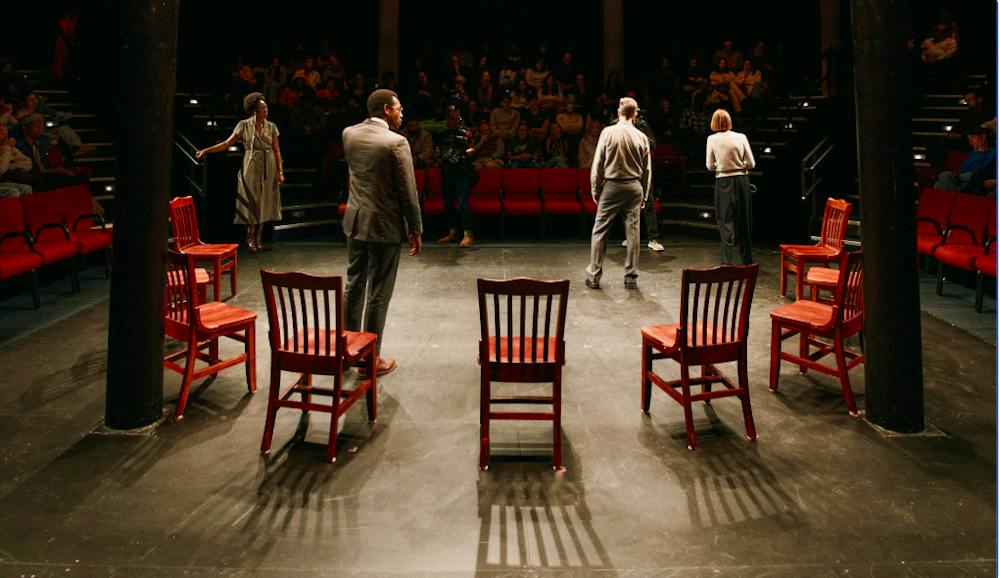
Nine chairs. Four actors. Two victims. Two Supreme Court nominees. Twenty-seven years apart.
“The Ford/Hill Project” is verbatim theater, which is a form of documentary theater which draws its dialogue word-for-word from real historical sources. The full performance, which was on show at Wright Memorial Theatre last week, is made entirely from the transcripts of two hearings: Anita Hill (played by MaYaa Boateng) testifying against Clarence Thomas (Amara James Aja) in 1991 and Christine Blasey Ford (Christina Kirk) testifying against Brett Kavanaugh (Roderick Hill) in 2018. The play parallels two women speaking up against two Supreme Court nominees for sexual violence nearly 30 years apart.
My first direct exposure to this style of theater came when associate director, Francesca Sabel, visited our Contemporary Women and Non-Binary Playwrights class. In class, Sabel played a clip from the recent hearing in which Sen. Eric Schmitt, R-Mo., accused special counsel Jack Smith of perjury after mistakenly confusing the Atlanta Hawks NBA team with the Iowa Hawkeyes college basketball team. We were then challenged to cut the text down to a 90-second snippet.
Creating our own interpretation of the theatre form helped us to understand its value and the possibilities it creates. Working in groups of three, we each ended up with a different version. One group had different actors play one character; another started in the middle of a dialogue, immediately grabbing the audience’s attention; another singled out only the most hilarious parts without giving much context for the accusation. All provided completely new perspectives of the same hearing — and in doing that, we learned that intent behind how a text is presented dictates how it is received.
That lesson followed me to the show. The first thing you see walking into Wright Theatre is nine chairs arranged in a semicircle. The set design is simple, stripping the story down to its most essential elements, drawing focus to the actors and dialogue — the crux of a piece that aims at retelling these hearings as truthfully as possible.
I noticed the actors put on their headphones on stage instead of walking on with them. An intentional choice, the brightly colored headphones are meant to be seen. They took their time, did the sound check and signaled to the stage manager that the devices worked. The testimonies were played through the headphones in real time and the cast delivered the words verbatim. Sabel mentioned that actors tend to articulate better than real people, so the headphones help them replicate stutters and coughs as best they can.
The stage blocking was just as deliberate. Although not every chair was used, it was clear that whenever they sat in a different chair, a character change followed. The only change that took me a while to comprehend was when both male actors sat stage center and took on Ford and Hill. Confusing me at first, I have come to understand that the choice makes the case for the primacy of the testimony, above all else. The stage remained lit in a bright wash that did not single anyone out, anchored by a blue was on the back wall. It painted the image of a neutral and sterile courtroom, only turning dramatic at key moments, such as during Ford and Hill’s opening statements.
What struck me the most was this parallel narrative of the two opening statements. The director positioned them side by side and had them interweave their speeches. The text was perfectly edited to make the speech easy to follow; I was able to hold one story in my head and listen to another.
What Dr. Ford experienced was physical violence: she accused Kavanaugh of sexually assaulting her during a high school gathering when she was 15. She stated under oath that Kavanaugh was her attacker and “feared he might accidentally kill [her]” before she managed to escape. Twenty-seven years before this, Dr. Hill testified that Thomas, her then-boss, continuously sexually harassed her with multiple personal date invitations and vulgar comments.
Dr. Ford and Dr. Hill’s speeches were filled with certainty and phrased in composed language, which contrasted the absurd and brutal experiences they were retelling. Thomas and Kavanaugh reacted emotionally and denied all accusations when they were testified against. Upon being questioned, Kavanaugh even asked Senator Amy Klobuchar (D-MN) whether she had ever blacked out from drinking.
The show ended with “Make It Right,” an indie pop song sung by The Tune-Yards, as the two male actors put on the Supreme Court Justices’ robes. The extra-large robes contrasted with the minimalistic set. The music initially caught me off-guard, but when I started listening to the lyrics, I realized they are notably asking for punishment, healing and an attempt to “make it right.”
The show does not claim that justice always wins, and it ended on a depressing note. One would think that after two scandalous testimonies, the two nominees would not become the Supreme Court Justices. Though the two women detailed their experiences, showed their scars and risked their reputations, there were not any consequences for their abusers.
For perpetrators, the cost of abuse has been low for a long time — and it still is. People will not find the courage to speak up until the abusers are held accountable for their actions. The recent “Cornell 7” case reflects the same problem: it took a woman producing a 100-page document of evidence before people began to notice the victim.
The Ford/Hill Project is not Friday night entertainment, and it does not try to be. It gives you the words verbatim and leaves the judgment for you to grapple with. While the hearings were held in 1991 and 2018, its relevance has not faded. That is one of the things theater does well: it can bring to life stories from the archives of the past.


