
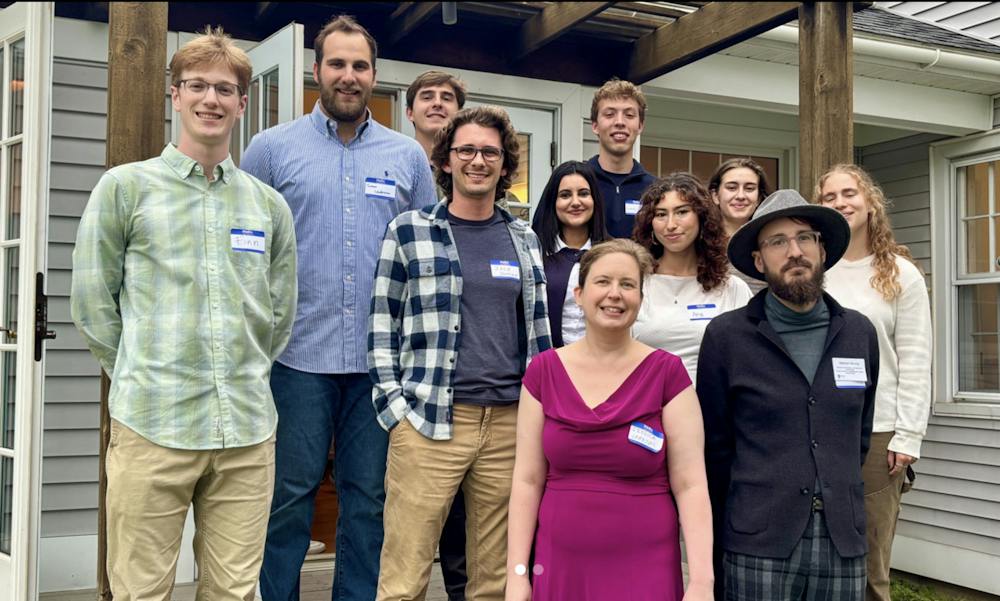
On Aug. 25, the James Martin Center for Nonproliferation Studies (CNS) announced that it would be opening an office at 46 South St., expanding its presence at Middlebury College and establishing a Vermont base for research, education and training on threats from nuclear, biological and chemical weapons.
“CNS is a Middlebury College research and education center focused on preventing the spread and use of the world’s most dangerous weapons. It is something you will not find at any other liberal arts college in the country,” Stephen Herzog, director of the CNS Middlebury office, said in a Sept. 24 interview published by the CNS.
The office joins the center’s locations in Monterey, California, Washington, D.C. and Vienna, Austria. According to the college’s opening announcement, the new space will deepen connections between CNS, the college and the broader Vermont community, bringing the organization’s work closer to students and faculty on campus.
An open house on Oct. 1 invited students, faculty, staff and local residents to explore the office and learn about the center’s presence in Middlebury. The announcement listed remarks from CNS and Middlebury leadership, followed by a panel highlighting work undertaken by Middlebury undergraduates with the center.
Guests were also invited to learn about campus activities, meet CNS experts and tour the space. By featuring both the office and undergraduate work, the event announcement presented the opening as a celebration of both the new location and the students, faculty and staff already connected to CNS.
Founded by William Potter in Monterey in 1989, CNS has spent more than 35 years preparing nonproliferation specialists. According to the Middlebury Institute of International Studies at Monterey’s website, it is the world’s largest nongovernmental organization devoted to curbing the spread of weapons of mass destruction.
The center combines research with education and professional training.
“I was a Nonproliferation Research Fellow in Monterey this past summer, and I began a comparative research study on civil defense frameworks between the U.S. and Japan. Now that Professor Herzog is at Middlebury, I can continue this study through an independent research project with him and travel to Japan to conduct my interviews. I think this new office is just what Middlebury needs to allow students to pursue a niche discipline like nonproliferation,” Aria Saines ’27 wrote in an email to The Campus.
CNS experts include former senior government officials, giving students access to practitioners as well as researchers. This combination connects the center’s educational work with experience in government and ongoing research into nonproliferation issues.
Programs focus on international organizations, export controls and chemical and biological weapons. Their work includes studying treaty implementation, illicit procurement networks and technologies with both civilian and military applications. The center also provides preparedness training for incidents involving chemical and biological terrorism.
In a Sept. 8 message published on the CNS website, Potter connected the opening with the center’s existing relationships at Middlebury.
“Having witnessed the exceptional skills of Middlebury students and alumni in all our offices, we welcome the opportunity to deepen our engagement with the Middlebury College community,” he said in the message.
With a permanent campus location, those established connections now have a local base linking the college community to the center’s international network.
“In this way, CNS Vermont will offer students an on-campus window into Middlebury’s global reach,” Potter said.
The Vermont office also provides employment opportunities closer to campus. According to the CNS Vermont internship announcement, undergraduate positions are available during fall, winter term, spring and summer, alongside summer fellowships in Monterey.
“My experience as the first Vermont Office Summer Intern for CNS was extremely rewarding and helpful for my professional development. My project examined the causal mechanisms behind cross-national variation in public opinion on nuclear deterrence among European NATO member states,” Ella Gincherman ’27 wrote to The Campus.
Stephen Herzog emphasized the importance of the CNS office on campus, as it builds opportunities previously available only through the center’s other activities and offices.
“The Vermont office is about finally making these opportunities part of everyday life at the College,” Herzog said in the interview.


