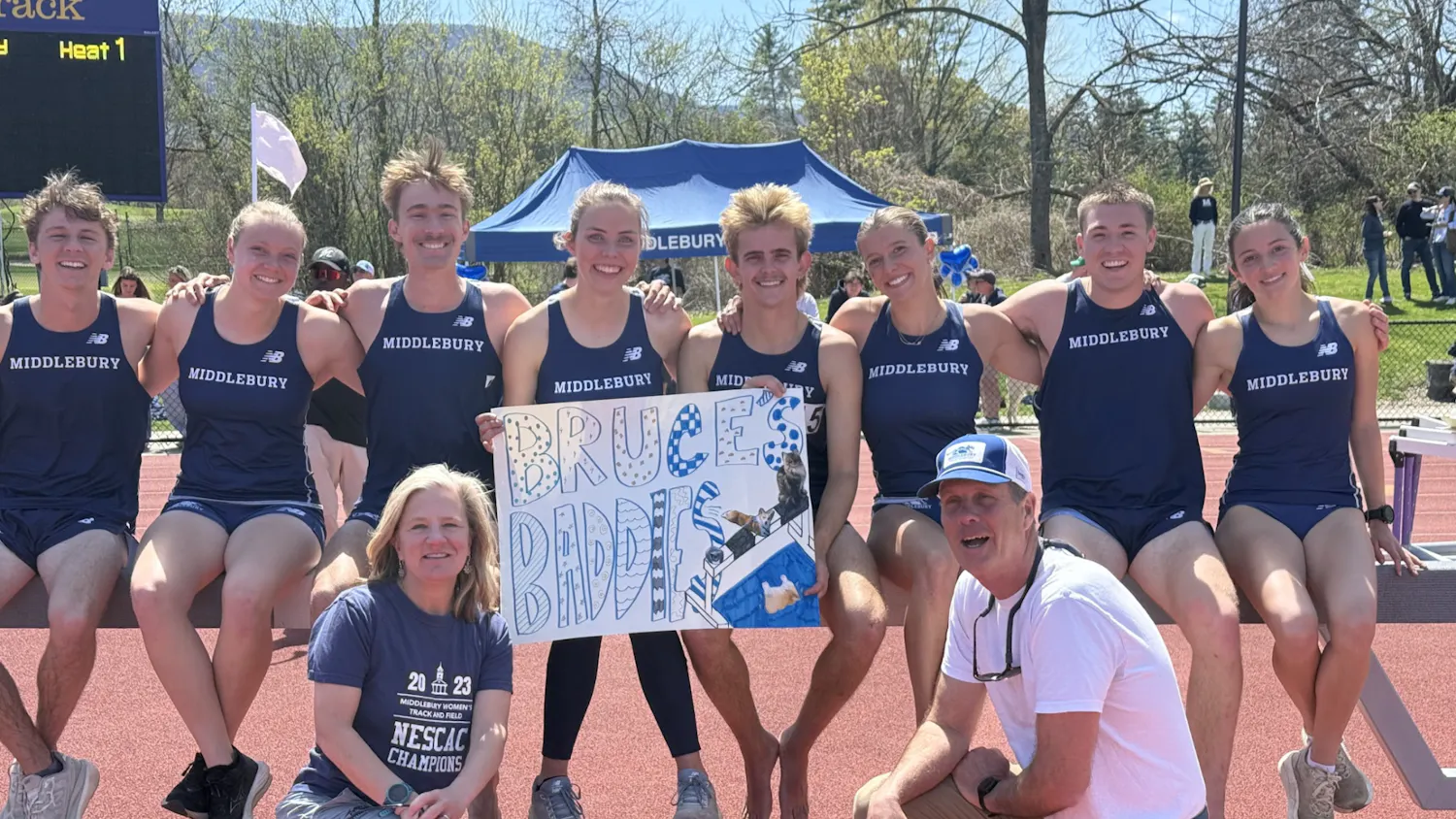
Being diagnosed with a femoral stress fracture in September of your first semester is not the ideal way to begin a college running career. Even once your new bone cells have filled in the cracks, certain mental fault lines may persist. You’ll question what could’ve been so wrong for such an injury to occur in the first place, and you’ll notice and hyperfixate on the smallest pain. The emotional urge to resume training will outpace your physical readiness to return. You’ll feel out of balance with yourself.
Yet the team is your identity on campus. Almost every day of the week, you spend the hours between 4:30 p.m. and 7:30 p.m. together. You take classes with your teammates, you do homework with your teammates and you party with your teammates. You’ll never eat alone because there’s always a table, at any time in any dining hall, at which someone on the team is sitting. Absent the nagging mental and physical inconsistencies, life is sweet.
You’ll feel guilty soon enough — guilty that you haven’t actually raced, that you’re a free rider enjoying the status of a varsity athlete without doing the work. And by the time you’re physically ready to run, you’re overzealous. Your mind may remember what 50 miles per week feels like, but the body is quick to forget. It doesn’t take long for a second stress fracture to form, and before your second year even begins, the cycle restarts.
I love my former teammates and still live with the ’26 cross country friends and family. I smile thinking of the six other class years I’ve overlapped with, each with their own batch of characters and distinctive spirit. I feel connected to the current guys with whom I’ve never ran (even when they’re playing Fortnite in my common room), and still find myself saying “us,” “we” and “our” when talking about the team in the dining halls. But to constantly test the dissonance between your mind and body, to want to run distances and speeds your legs can’t handle, just to maintain an identity, is no way to spend college.
Being stuck between identities is no way to spend college, either. Part of the difficulty in quitting a varsity sports team is the apparent chasm that waits on the other side of not having an online roster photo. How will you fill your time? Who will you get dinner with? What do you do on the weekends when everyone is gone? It’s a privilege to show up with an instant 50-person friend group, but it isn’t conducive to learning how to make new friends. I entered the second half of my time at Middlebury facing these questions, and I ultimately found my answer through The Campus.
I started in my comfort zone, covering the 2024 TAM Trek for my first article. Standing at the Wright Park finish line, conducting interviews through Voice Memos and tracking my thoughts on my Notes app, I felt an empowerment in simply walking up to others and letting them talk. I had interviewed my high school friends on camera as a joke before, but this was different. This felt like adults taking each other seriously. By saying I was from the newspaper, the tone of conversation changed, and it compelled me to listen closely — to understand the story I was being told.
My interview for Senior Sports Editor took place as I sat in my dorm in Potsdam, Germany. Having endured the vetting process of Murray Dry’s Constitutional Law course together, Ting Cui ’25.5, the previous Senior Sports Editor, decided that I was sufficiently locked in for the job. I returned to campus motivated to confirm that belief, and Ting was instrumental in guiding me through the role, from showing me the ropes of the master spreadsheet to reminding me of the correct direction of grade-year apostrophes.
Ting’s help, along with the support of the rest of our team — Theo Maniatis ’28.5, Kanan Clifford ’28.5, Thie Harthono ’28 and Brooke Friberg ’26 — has enabled me to find joy in filling this role. From shooting photos of the club sailing team’s FJs on a skiff to trekking through the snowy Rikert woods amid the deafening roar of chainsaws, becoming the Senior Sports Editor has redefined my identity and purpose at Middlebury.
It has been my goal to redefine what the sports section can be. It isn’t pleasant to feel redundant, and when Middlebury Athletics can cover a story in real-time, with more photos and statistics than anyone could ever need, it is important to ask what The Campus sports section can provide. I have tried to move beyond mere game coverage, to do and cover what Middlebury Athletics normally can’t. I started the Tapped-in column as a result — a way to feature the quirky things Middlebury’s athletes do. I have tried to highlight club sports, to speak to athletes outside of the varsity mold, to bring out the stories and individual voices that make Middlebury’s athletic scene unique.
Thank you to the rest of The Campus staff and to all the students, athletes and coaches who gave me the time to interview them. I looked forward to transcribing every interview, to reliving the conversation and mentally arranging each quote collage. It’s been a privilege to hear and retell your stories, and I can only hope that each article made clear my satisfaction in doing so.
Simon Schmieder '26 (he/him) is a Senior Sports Editor.
Simon is an avid runner and biker and enjoys spending time outdoors. He is a philosophy and political science joint major with a minor in German, in addition to being a Philly sports fan.