The University of Vermont’s (UVM) Morgan Horse Farm will commence its 2026 tourist season on May 2, which will run until October 27. The farm is dedicated to preserving and promoting the Morgan horse breed as well as providing hands-on educational experiences to students and the general public.
The farm has preserved the same herd of Morgan horses since its establishment in 1878. Originally a privately owned farm commissioned by Colonel Joseph Battell, it became the U.S. Government Morgan Farm in 1907 before UVM became its steward in 1951. Operating under the leadership of Director Margot Smithson, the farm has prospered for over 100 years, making it the world's oldest Morgan horse breeding program.
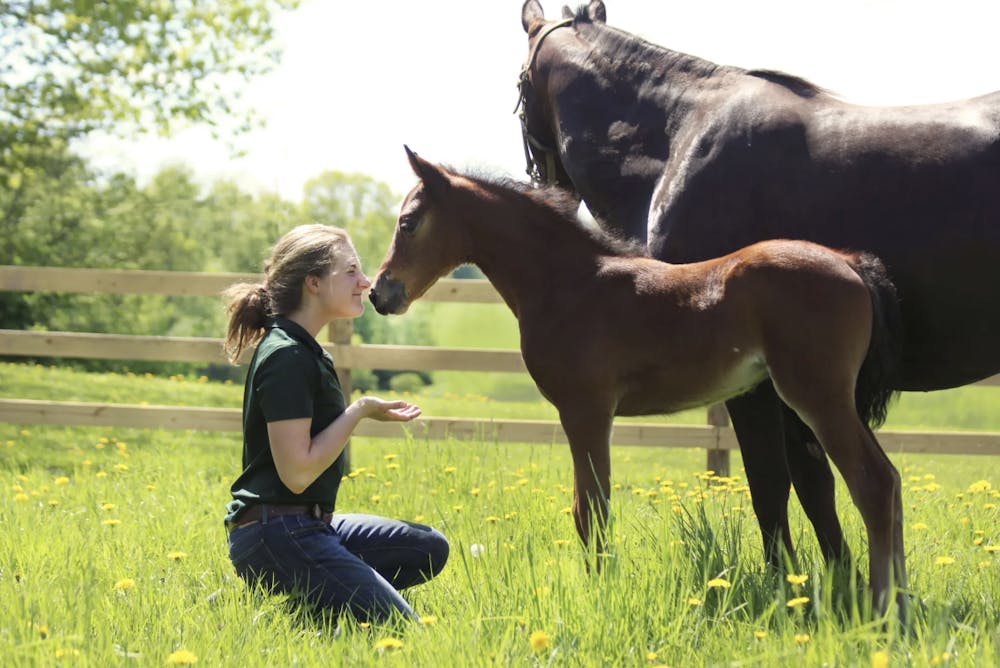
With over 40 Morgan horses living there today, the farm serves as a teaching facility for both students and the broader public. The Morgan Horse Farm offers an apprenticeship program for UVM students, in which students live on the premises for a year and gain hands-on experience caring for a breeding herd similar in size to the Morgans' herd.
Additionally, the farm offers an internship program for students at institutions other than UVM who wish to learn about Equine Sciences and Management.
Margot Smithson explained that the Morgan Horse Farm currently operates as an active breeding and training farm, offering numerous learning opportunities for interested students and providing educational opportunities for visitors.
“We breed anywhere between five to 10 mares a year. What that looks like from an educational standpoint is each apprentice and intern, if we have someone who's interested in reproduction, will come and monitor the brood mare and take her through her gestation and what's required for that… It's great the apprentices each kind of get assigned a brood mare, and they kind of are the one, the point person, for that mare as they go through,” Smithson said in an interview with the Campus.
Smithson also explained the process of raising and eventually selling some of the horses once they are old enough.
“We take the natural talents and attributes of each foal and mash them up with a partner that's going to take them in the direction that they're best suited for out in the world…that's the main point of our mission, is to preserve and promote the Morgan horse. And so part of that is breeding them as sales horses for people to go and find their own Morgan partner to do cool stuff with,” she said.
Much of the Morgan Horse Farm’s mission today has developed as a result of the efforts of the farm’s original owner, Colonel Joseph Battell, who deeply admired the Morgan horse breed. During his life, he maintained them at what was known as the Weybridge Stock Farm and helped save the breed from extinction.
“Joseph Battell thought Morgan horses were the best driving horses at the time,” Smithson said. “He just dedicated himself to breeding them, and to establishing his farm out in Weybridge.”
As for the Morgan breed, they hold a rich history dating back to the early days of the United States.
“There's a Marguerite Henry book called ‘Justin Morgan Had a Horse,’ and the breed originated from one foundation sire who had very, very strong genetics,” Smithson said. “That horse was later called Justin Morgan, or the Morgan horse, after his owner. And he kind of created, through his really strong genes, this type of horse that was called the Morgan horse, and it was bred widely in Vermont and New England, and was the central pioneer horse. She also shared that the Morgan horse breed was bred to be substantive with a lot of muscle and bone, capable of aiding people in various types of difficult labor. Smithson described the Morgan as on the border of a pony and a horse, stating that it was popular in Vermont due to its small size and strength.
The aligned development of the Morgan horse breed and the United States is particularly striking, making the breed a quintessentially New England – and in particular, Vermont – horse, as Smithson explained.
“The figure was born in 1789, which is the same year that the US Constitution was ratified, so the breed is connected to the early days of the United States and definitely New England, especially Vermont. And that's why the Morgan horse is the state animal of Vermont; because of its history and because of the legacy of the Morgan Horse Farm.”
Formal tours of the Morgan Horse Farm have existed since about the 1970s, although Smithson mentioned that before then, members of the public often came to see the horses.
“During the USDA’s tenure of the farm, they would do applied agricultural research and demonstrations. So there was always a history of people coming and seeing the Morgans at the farm. They would hold 4 each day, a couple times a year, and they would show off the breeding stock,” she said.
Formal tours of the farm began to be offered once UVM took over the property, and demand for agrotourism rose. Much of the touring experience has remained the same, Smithson explained, with only minimal changes.
“Over time, we've kept it going. A lot of it’s the same, honestly, as it was back then. And then we've made a lot of improvements as well, as well to the guest experience, but the heart of it is the same, which is teaching about Morgans and their connection to Vermont,” she said.
Additionally, Smithson emphasized the importance of educating visitors on the environmental impact of the farm and the work that is done in operating it.
“What I want to continue to involve in the story of the farm is how we manage the entire facility,” Smithson said. We have 200 acres, and so how are we being a good steward of the land and the forest ecosystem, and how does that integrate with the horses? Because it's not just about pretty Morgans. It's about how are we taking care of the land that supports the horses? And so, I want people to have an understanding of that larger system and how important that is to protect and take care of our agricultural programs."