
In late October of 2022, during my first year at Middlebury, I drove over the Green Mountains and into New Hampshire to see one of my best friends from high school for the last time. Though his eyes shone with their same flinty strength, cancer had weakened his body. After catching up for an hour in a surprisingly normal and lighthearted conversation, he had to go back to his room to sleep. I told him we all loved him and cared about him very much, and his last words to me were “I know.”
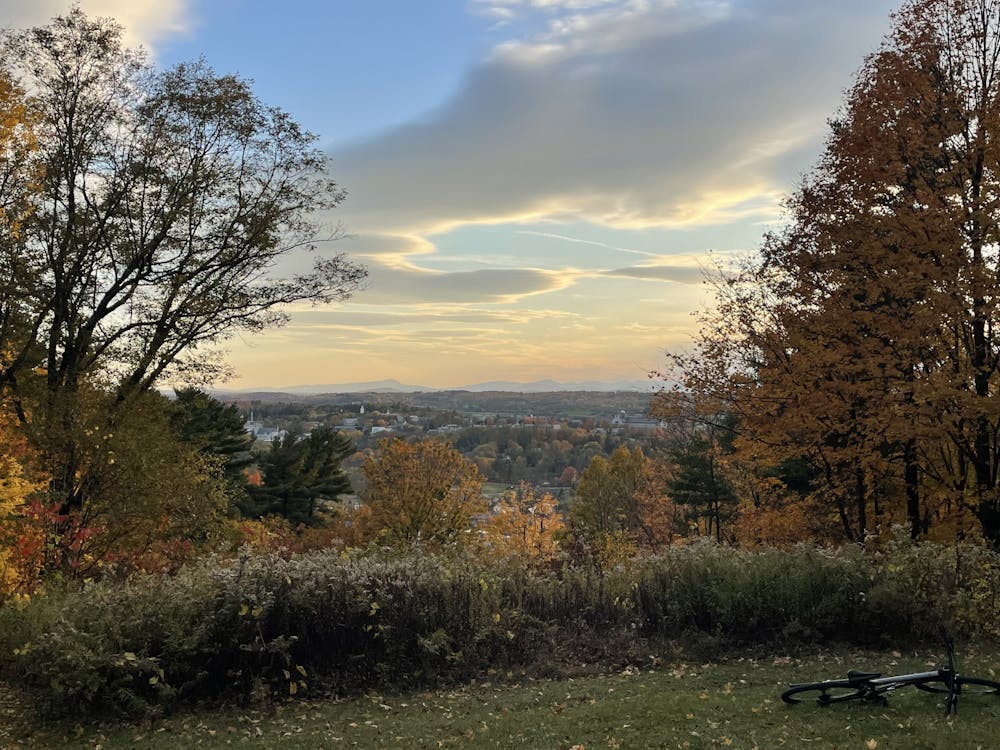
In the following month, I rode my bike up Chipman Hill, went to parties with my friends, studied the Keynesian model of aggregate demand, drank horchata in Battell’s bright yellow common room, swam some laps and helped plan a Friendsgiving meal. However, I also cried myself hoarse in a counselor’s office, paced up and down a putrid stairwell trying to collect my thoughts in a voice memo and wandered around this halcyon campus at 5 a.m. in a state of delirium.
The experienced phenomenon of grief always involves endless permutations of the mundane and the existential. For me, a typical day involved thoughts about unimaginable suffering, my dead car battery and the use cases of the Spanish subjunctive. This strange combination of feelings was heightened by the loneliness of a campus that didn’t fully understand me. It was a time where I could talk about how I was feeling, but I could never transmit what it was like to have the experience of grief itself.
Despite the peculiarity and intensity of the process, I did feel supported at Middlebury. My friends and professors gave me latitude to do what I needed to feel whole again, whether that meant continuing with my normal life or taking time to reflect. But the onus was on me, as an individual, to figure out what I needed. We live, after all, in a place where communitarian cultural and religious values are subservient to individual autonomy and secularism. I love studying here at Middlebury, which is a place that has challenged me academically and educated me from different cultural, religious and philosophical perspectives. Though I wouldn’t change the college’s pluralism, packed schedules and academic challenges for anything, I also think that they can lead to feelings of alienation in times of loss, like we’re going through in our community right now.
Loss and its resultant alienation are some of the most difficult problems we face, and I don’t pretend to have easy answers. Sometimes loss will feel like a dull pain, other times it will feel like an open wound. Sometimes it will make the world around you feel more meaningful, other times it will make even a beautiful scene feel hopeless and bleak. Because I’m not part of a religion that has defined customs for the grieving process, I found solace in trying a bunch of stuff. I went to meditation, called my family members, made food with my friends and looked at the trees on unfamiliar paths. I looked at old photos, played old songs and wrote about my feelings. Though I skipped a few classes, I made an effort academically and tried to get to know my professors more closely.
Above all else, my advice is to spend time in the company of other people. I don’t know what exactly helps us during loss, but I am sure that we’re not meant to be alone in the process. It can feel lonely on this campus, where grief always coexists with the sea of the nongrieving, with all their parties, all-nighters and everyday gossip. Know that one day, the throes of grief will lessen, perhaps with a perverse aftertaste of longing to grieve again, because it at least offers an emotional connection to the dead. Remember to not feel guilty about the ways in which you grieve or how you feel afterward. It’s an inherently indescribable and senseless process exacerbated by a community that doesn’t provide much of a script. Though it can be lonely, I hope this op-ed makes you feel a little less alone.
